Hydrology, Vol. 11, Pages 15: Meteorological Signal on Hydrodynamics in the Ilha Grande and Sepetiba Bays: Lag Effects and Coastal Currents
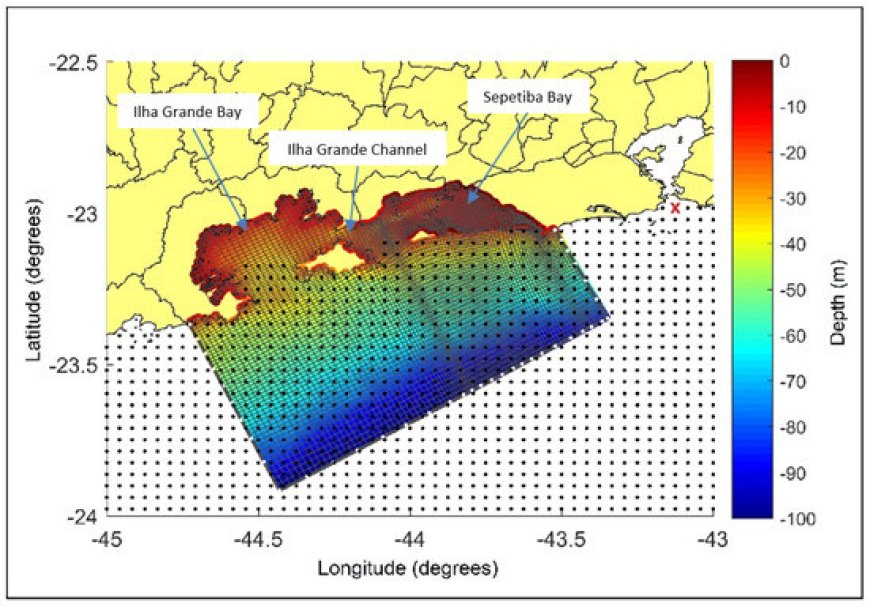
On the southeastern coast of Brazil, the bays of Ilha Grande and Sepetiba are linked by the Ilha Grande Channel, where remarkably strong currents have been consistently observed. Tidal forces cannot explain the strength of these currents. Previous researchers have focused on investigating factors like baroclinic effects due to salinity differences or seiches between two basins without a conclusive answer. This study aims to elucidate the role of remote meteorological effects within this complex hydrodynamic system. A numerical approach with a coastal model nested within an ocean model was employed, enabling an in-depth examination of the intricate interplay between meteorological and tidal forcings. The study revealed a significant finding: the lag in signal propagation plays a pivotal role in determining how these signals impact the dynamics of the bays. The astronomical signal exhibits a minimal lag along the coast (1 min) and leads to water level differences between the sea and the coastline, resulting in the generation of tidal currents at the bay entrances. On the other hand, the remote meteorological signal, with a stronger signal lag along the coast (4.92 h), leads to the creation of a water level difference between the bay entrances, inducing significant fluxes along the narrow Ilha Grande Channel.
Hydrology, Vol. 11, Pages 15: Meteorological Signal on Hydrodynamics in the Ilha Grande and Sepetiba Bays: Lag Effects and Coastal Currents
Hydrology doi: 10.3390/hydrology11020015
Authors: Nair Emmanuela da Silveira Pereira Susana Beatriz Vinzón Marcos Nicolás Gallo Mariela Gabioux
On the southeastern coast of Brazil, the bays of Ilha Grande and Sepetiba are linked by the Ilha Grande Channel, where remarkably strong currents have been consistently observed. Tidal forces cannot explain the strength of these currents. Previous researchers have focused on investigating factors like baroclinic effects due to salinity differences or seiches between two basins without a conclusive answer. This study aims to elucidate the role of remote meteorological effects within this complex hydrodynamic system. A numerical approach with a coastal model nested within an ocean model was employed, enabling an in-depth examination of the intricate interplay between meteorological and tidal forcings. The study revealed a significant finding: the lag in signal propagation plays a pivotal role in determining how these signals impact the dynamics of the bays. The astronomical signal exhibits a minimal lag along the coast (1 min) and leads to water level differences between the sea and the coastline, resulting in the generation of tidal currents at the bay entrances. On the other hand, the remote meteorological signal, with a stronger signal lag along the coast (4.92 h), leads to the creation of a water level difference between the bay entrances, inducing significant fluxes along the narrow Ilha Grande Channel.
What's Your Reaction?