AI, Vol. 5, Pages 504-515: Towards an ELSA Curriculum for Data Scientists
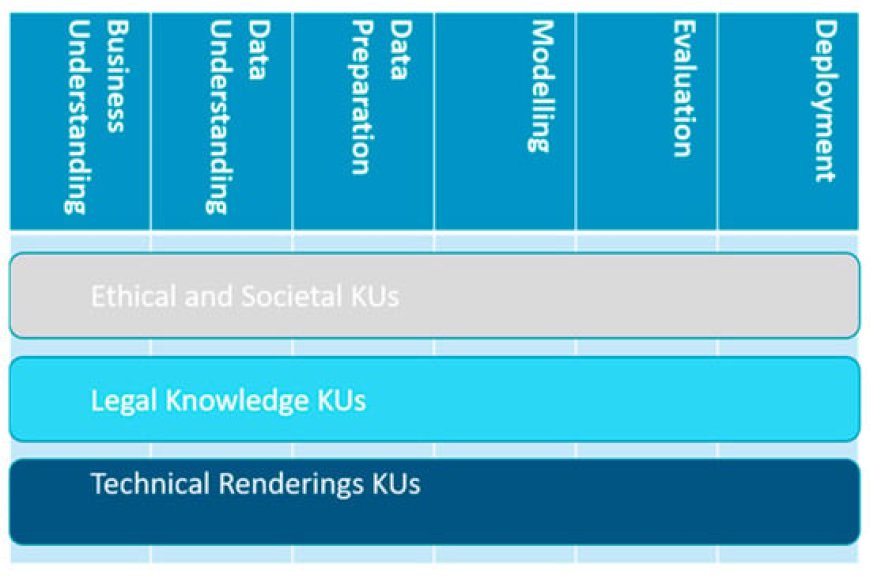
The use of artificial intelligence (AI) applications in a growing number of domains in recent years has put into focus the ethical, legal, and societal aspects (ELSA) of these technologies and the relevant challenges they pose. In this paper, we propose an ELSA curriculum for data scientists aiming to raise awareness about ELSA challenges in their work, provide them with a common language with the relevant domain experts in order to cooperate to find appropriate solutions, and finally, incorporate ELSA in the data science workflow. ELSA should not be seen as an impediment or a superfluous artefact but rather as an integral part of the Data Science Project Lifecycle. The proposed curriculum uses the CRISP-DM (CRoss-Industry Standard Process for Data Mining) model as a backbone to define a vertical partition expressed in modules corresponding to the CRISP-DM phases. The horizontal partition includes knowledge units belonging to three strands that run through the phases, namely ethical and societal, legal and technical rendering knowledge units (KUs). In addition to the detailed description of the aforementioned KUs, we also discuss their implementation, issues such as duration, form, and evaluation of participants, as well as the variance of the knowledge level and needs of the target audience.
AI, Vol. 5, Pages 504-515: Towards an ELSA Curriculum for Data Scientists
Authors: Maria Christoforaki Oya Deniz Beyan
The use of artificial intelligence (AI) applications in a growing number of domains in recent years has put into focus the ethical, legal, and societal aspects (ELSA) of these technologies and the relevant challenges they pose. In this paper, we propose an ELSA curriculum for data scientists aiming to raise awareness about ELSA challenges in their work, provide them with a common language with the relevant domain experts in order to cooperate to find appropriate solutions, and finally, incorporate ELSA in the data science workflow. ELSA should not be seen as an impediment or a superfluous artefact but rather as an integral part of the Data Science Project Lifecycle. The proposed curriculum uses the CRISP-DM (CRoss-Industry Standard Process for Data Mining) model as a backbone to define a vertical partition expressed in modules corresponding to the CRISP-DM phases. The horizontal partition includes knowledge units belonging to three strands that run through the phases, namely ethical and societal, legal and technical rendering knowledge units (KUs). In addition to the detailed description of the aforementioned KUs, we also discuss their implementation, issues such as duration, form, and evaluation of participants, as well as the variance of the knowledge level and needs of the target audience.
What's Your Reaction?