Water, Vol. 16, Pages 1172: Adsorptive Removal of Sb(V) from Wastewater by Pseudo-Boehmite: Performance and Mechanism
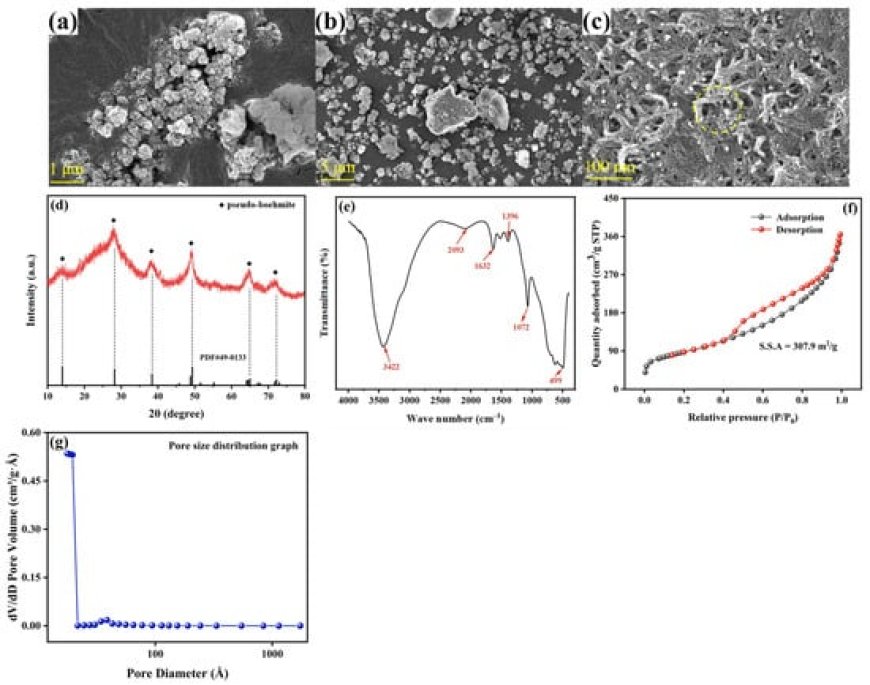
With the increasing concern about antimony (Sb) pollution and remediation in aquatic ecosystems, more and more feasible technologies have been developed. Adsorption has been extensively studied due to the simplicity of its operation and its minimal environmental effects, but the lack of cheap and stable adsorbents has limited its application in Sb treatment. In this study, pseudo-boehmite (PB) was successfully synthesized via aluminum isopropylate hydrolysis, and its potential for removing Sb(V) from wastewater was explored. The removal efficiency of Sb(V) was 92.50%, and the maximum adsorption capacity was 75.25 mg/g under optimal conditions (pH 5.0, 2 g·L−1 PB, and 10 mg·L−1 Sb(V)). In addition, better performance could be obtained at acidic conditions (pH 3.0–5.0). Surface complexation, electrostatic attraction, and hydrogen bonding were identified as potential major processes for Sb(V) elimination by PB based on experimental and characterization data. This study presents a promising approach for the efficient removal of Sb(V) from wastewater, offering a new insight into the application of aluminum-based materials for heavy metal removal.
Water, Vol. 16, Pages 1172: Adsorptive Removal of Sb(V) from Wastewater by Pseudo-Boehmite: Performance and Mechanism
Water doi: 10.3390/w16081172
Authors: Yating He Qiming Mao Yaoyu Zhou Xiande Xie Lin Luo
With the increasing concern about antimony (Sb) pollution and remediation in aquatic ecosystems, more and more feasible technologies have been developed. Adsorption has been extensively studied due to the simplicity of its operation and its minimal environmental effects, but the lack of cheap and stable adsorbents has limited its application in Sb treatment. In this study, pseudo-boehmite (PB) was successfully synthesized via aluminum isopropylate hydrolysis, and its potential for removing Sb(V) from wastewater was explored. The removal efficiency of Sb(V) was 92.50%, and the maximum adsorption capacity was 75.25 mg/g under optimal conditions (pH 5.0, 2 g·L−1 PB, and 10 mg·L−1 Sb(V)). In addition, better performance could be obtained at acidic conditions (pH 3.0–5.0). Surface complexation, electrostatic attraction, and hydrogen bonding were identified as potential major processes for Sb(V) elimination by PB based on experimental and characterization data. This study presents a promising approach for the efficient removal of Sb(V) from wastewater, offering a new insight into the application of aluminum-based materials for heavy metal removal.
What's Your Reaction?