Water, Vol. 16, Pages 1116: Extracellular Polymeric Substance Composition Effects on Biosorption for Primary Carbon Diversion
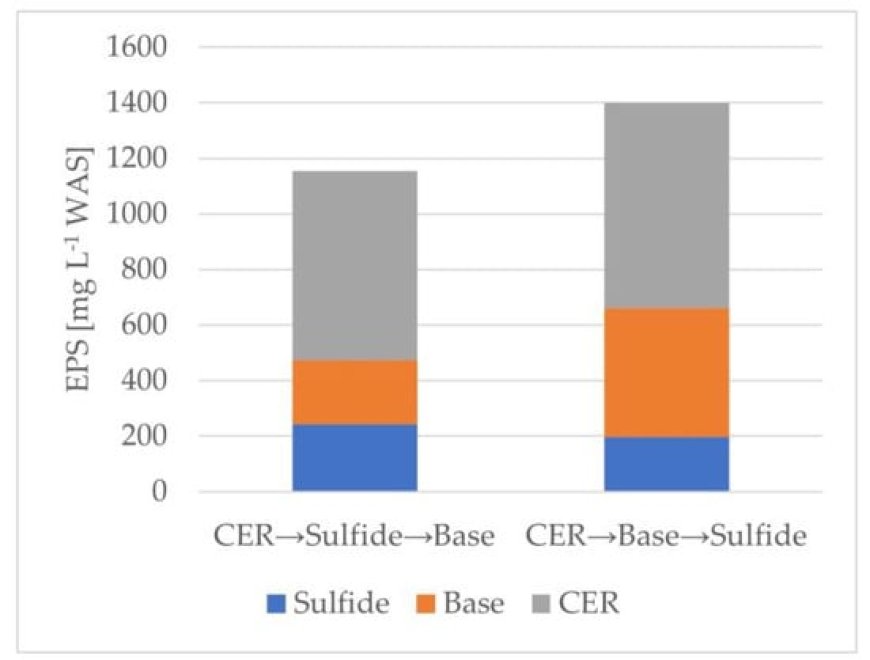
This paper characterizes the composition of extracellular polymeric substances (EPSs) in different types of activated sludge (AS) processes and analyzes the biosorption of soluble organics when waste AS (WAS) is mixed with raw wastewater for primary carbon diversion. The fraction of AS organics identified as EPSs was 26% in a membrane bioreactor (MBR), 54% in conventional AS (CAS), and 51% in a trickling filter/solids contact (TF/SC) process. EPSs were found to be approximately 15% carbohydrates, 40% proteins, 40% humics, and 5% uronics in CAS and MBR AS. Biosorption was not correlated to the organic portion (VSS) of the WAS; however, statistically significant correlations were found for the total amount of EPSs (for TF/SC and CAS) and the protein fraction (for TF/SC and MBR) in the VSS. EPSs from different types of AS biosorbed the same amount of soluble organics, removing 1.43 ± 0.15 (n = 16) mg of soluble chemical oxygen demand (sCOD), and 1.20 ± 0.18 (n = 16) mg of truly soluble COD (ffCOD), per mg of cation exchange resin (CER) total extracted EPSs. Utilizing multiple extraction methods in series (CER–base–sulfide) increased EPS extraction yields by nearly 100% relative to CER alone and indicated different EPS fractionization for CAS (a smaller fraction of carbohydrates and a larger fraction of humics).
Water, Vol. 16, Pages 1116: Extracellular Polymeric Substance Composition Effects on Biosorption for Primary Carbon Diversion
Water doi: 10.3390/w16081116
Authors: Tiow Ping Wong Roger W. Babcock Theodore Uekawa Joachim Schneider
This paper characterizes the composition of extracellular polymeric substances (EPSs) in different types of activated sludge (AS) processes and analyzes the biosorption of soluble organics when waste AS (WAS) is mixed with raw wastewater for primary carbon diversion. The fraction of AS organics identified as EPSs was 26% in a membrane bioreactor (MBR), 54% in conventional AS (CAS), and 51% in a trickling filter/solids contact (TF/SC) process. EPSs were found to be approximately 15% carbohydrates, 40% proteins, 40% humics, and 5% uronics in CAS and MBR AS. Biosorption was not correlated to the organic portion (VSS) of the WAS; however, statistically significant correlations were found for the total amount of EPSs (for TF/SC and CAS) and the protein fraction (for TF/SC and MBR) in the VSS. EPSs from different types of AS biosorbed the same amount of soluble organics, removing 1.43 ± 0.15 (n = 16) mg of soluble chemical oxygen demand (sCOD), and 1.20 ± 0.18 (n = 16) mg of truly soluble COD (ffCOD), per mg of cation exchange resin (CER) total extracted EPSs. Utilizing multiple extraction methods in series (CER–base–sulfide) increased EPS extraction yields by nearly 100% relative to CER alone and indicated different EPS fractionization for CAS (a smaller fraction of carbohydrates and a larger fraction of humics).
What's Your Reaction?