IJERPH, Vol. 21, Pages 531: Substantial Increases in Healthcare Students’ State Empathy Scores Owing to Participation in a Single Improvisation Session
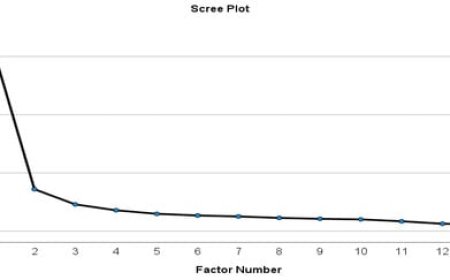
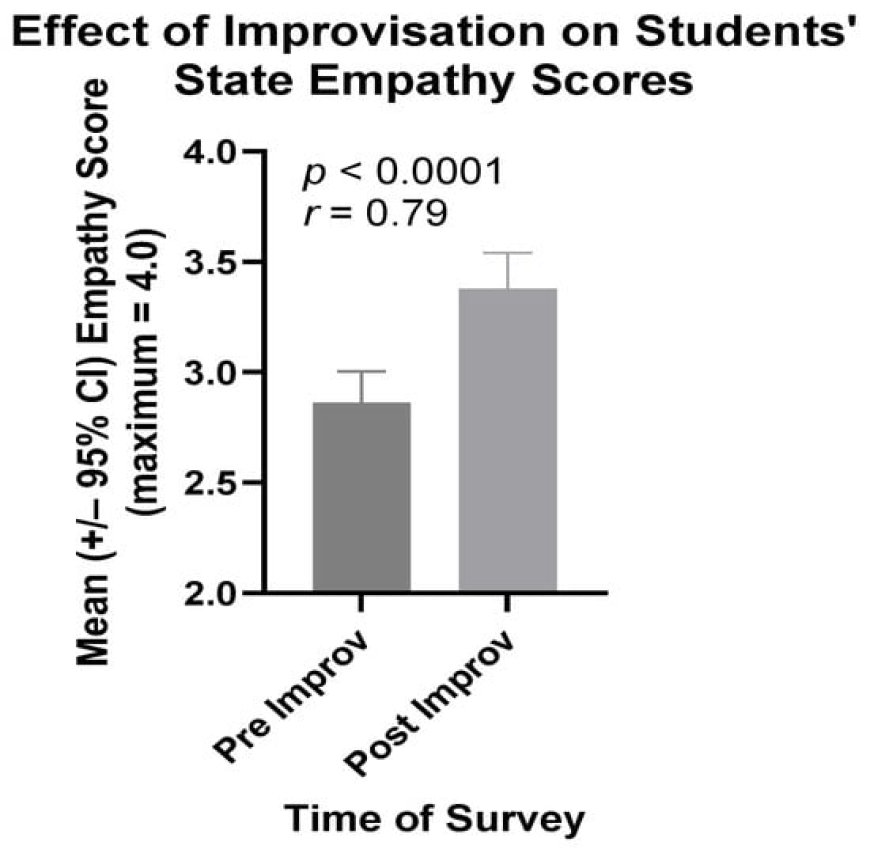
Purpose: To determine whether the 12-item state empathy scale could be modified reliably to measure empathy in healthcare professions students and to detect changes in their empathy owing to a single improvisation (improv) session. Methods: Three cohorts of students from two healthcare professions programs (total = 165 students) participated in an improv session. During the session, one of the researchers (BS) tasked the students with several improv activities. Participants’ self-reported state empathy scores were assessed at three time points (pre-improv, post-improv, and end of semester) using revised, in-class paper versions of the State Empathy Scale. Results: The exploratory factor analysis revealed a single factor solution for the revised scale, justifying the creation of an overall state empathy score from the questionnaire. Cronbach’s alpha reliability values averaged 0.87. Students’ mean empathy scores were higher directly after the improv session than directly prior to the session (p < 0.0001; effect size = r = 0.67, 0.55, and 0.79 for cohorts 1, 2, and 3, respectively). Conclusions: These findings show that a single one- or two-hour improv session can foster substantial increases in healthcare professional students’ state empathy for one another. Greater healthcare professional empathy and compassion foster better healthcare team cooperation and patient outcomes, so healthcare professionals and their students should engage in such empathy-enhancing activities at regular intervals throughout their training and careers.
IJERPH, Vol. 21, Pages 531: Substantial Increases in Healthcare Students’ State Empathy Scores Owing to Participation in a Single Improvisation Session
International Journal of Environmental Research and Public Health doi: 10.3390/ijerph21050531
Authors: Brian D. Schwartz Shane L. Rogers Nicole Michels Lon J. Van Winkle
Purpose: To determine whether the 12-item state empathy scale could be modified reliably to measure empathy in healthcare professions students and to detect changes in their empathy owing to a single improvisation (improv) session. Methods: Three cohorts of students from two healthcare professions programs (total = 165 students) participated in an improv session. During the session, one of the researchers (BS) tasked the students with several improv activities. Participants’ self-reported state empathy scores were assessed at three time points (pre-improv, post-improv, and end of semester) using revised, in-class paper versions of the State Empathy Scale. Results: The exploratory factor analysis revealed a single factor solution for the revised scale, justifying the creation of an overall state empathy score from the questionnaire. Cronbach’s alpha reliability values averaged 0.87. Students’ mean empathy scores were higher directly after the improv session than directly prior to the session (p < 0.0001; effect size = r = 0.67, 0.55, and 0.79 for cohorts 1, 2, and 3, respectively). Conclusions: These findings show that a single one- or two-hour improv session can foster substantial increases in healthcare professional students’ state empathy for one another. Greater healthcare professional empathy and compassion foster better healthcare team cooperation and patient outcomes, so healthcare professionals and their students should engage in such empathy-enhancing activities at regular intervals throughout their training and careers.
What's Your Reaction?