IJERPH, Vol. 21, Pages 505: Sexist, Racist, and Homophobic Violence against Paramedics in a Single Canadian Site
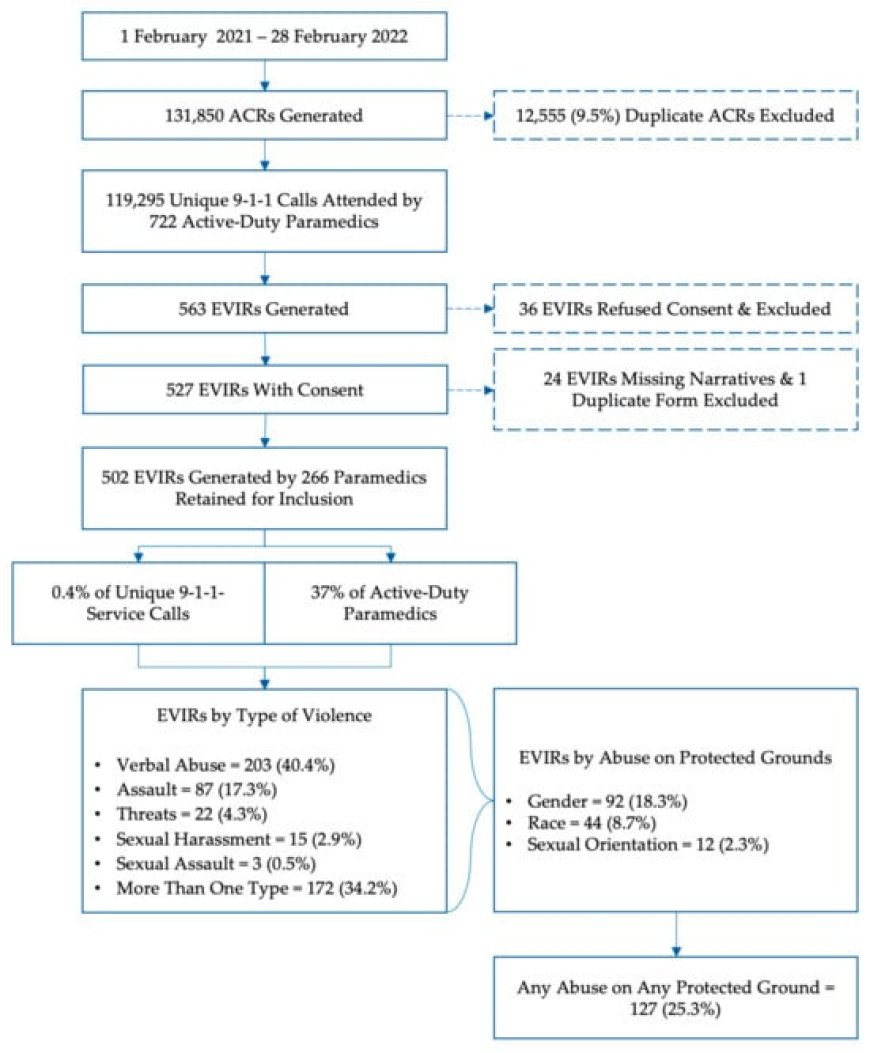
Violence against paramedics is widely recognized as a serious, but underreported, problem. While injurious physical attacks on paramedics are generally reported, non-physical violence is less likely to be documented. Verbal abuse can be very distressing, particularly if the harassment targets personal or cultural identities, such as race, ethnicity, gender, or sexual orientation. Leveraging a novel, point-of-event reporting process, our objective was to estimate the prevalence of harassment on identity grounds against paramedics in a single paramedic service in Ontario, Canada, and assess its potentially differential impact on emotional distress. In an analysis of 502 reports filed between 1 February 2021 and 28 February 2022, two paramedic supervisors independently coded the free-text narrative descriptions of violent encounters for themes suggestive of sexism, racism, and homophobia. We achieved high inter-rater agreement across the dimensions (k = 0.73–0.83), and after resolving discrepant cases, we found that one in four violent reports documented abuse on at least one of the identity grounds. In these cases, paramedics were 60% more likely to indicate being emotionally distressed than for other forms of violence. Our findings offer unique insight into the type of vitriol paramedics experience over the course of their work and its potential for psychological harm.
IJERPH, Vol. 21, Pages 505: Sexist, Racist, and Homophobic Violence against Paramedics in a Single Canadian Site
International Journal of Environmental Research and Public Health doi: 10.3390/ijerph21040505
Authors: Justin Mausz Joel D’Eath Nicholas A. Jackson Mandy Johnston Alan M. Batt Elizabeth A. Donnelly
Violence against paramedics is widely recognized as a serious, but underreported, problem. While injurious physical attacks on paramedics are generally reported, non-physical violence is less likely to be documented. Verbal abuse can be very distressing, particularly if the harassment targets personal or cultural identities, such as race, ethnicity, gender, or sexual orientation. Leveraging a novel, point-of-event reporting process, our objective was to estimate the prevalence of harassment on identity grounds against paramedics in a single paramedic service in Ontario, Canada, and assess its potentially differential impact on emotional distress. In an analysis of 502 reports filed between 1 February 2021 and 28 February 2022, two paramedic supervisors independently coded the free-text narrative descriptions of violent encounters for themes suggestive of sexism, racism, and homophobia. We achieved high inter-rater agreement across the dimensions (k = 0.73–0.83), and after resolving discrepant cases, we found that one in four violent reports documented abuse on at least one of the identity grounds. In these cases, paramedics were 60% more likely to indicate being emotionally distressed than for other forms of violence. Our findings offer unique insight into the type of vitriol paramedics experience over the course of their work and its potential for psychological harm.
What's Your Reaction?