IJERPH, Vol. 21, Pages 490: Multicomponent Behavioural Intervention during Pregnancy to Reduce Home Exposure to Second-Hand Smoke: A Pilot Randomised Controlled Trial in Bangladesh and India
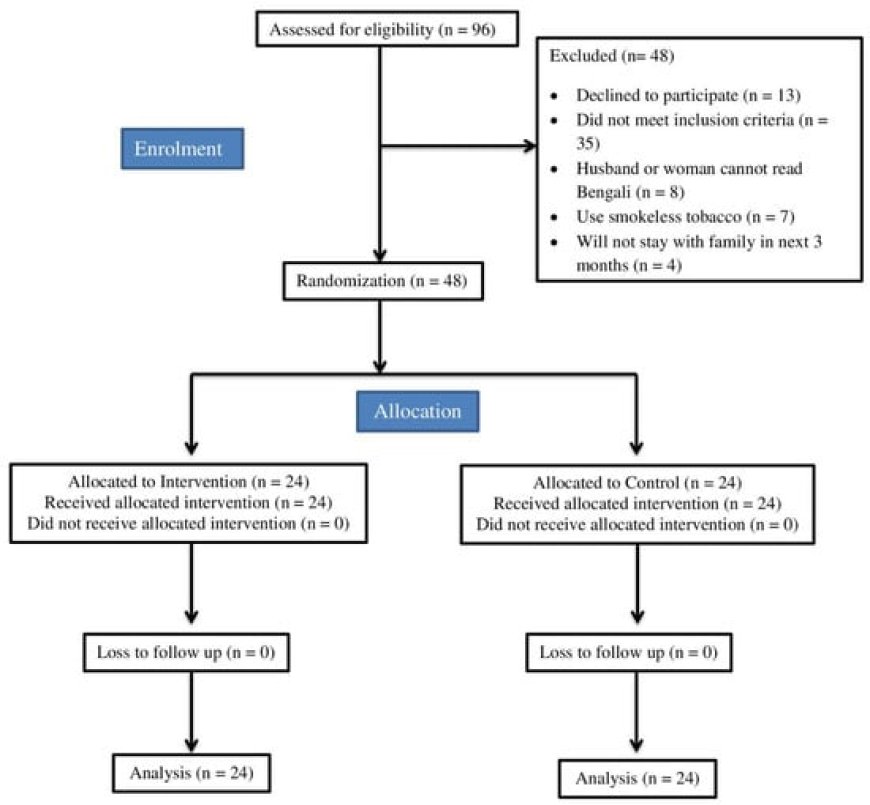
Background: Pregnant women exposed to second-hand smoke (SHS) are at increased risk of poor birth outcomes. We piloted multicomponent behavioural intervention and trial methods in Bangalore, India, and Comilla, Bangladesh. Methods: A pilot individual randomised controlled trial with economic and process evaluation components was conducted. Non-tobacco-using pregnant women exposed to SHS were recruited from clinics and randomly allocated to intervention or control (educational leaflet) arms. The process evaluation captured feedback on the trial methods and intervention components. The economic component piloted a service use questionnaire. The primary outcome was saliva cotinine 3 months post-intervention. Results: Most pregnant women and many husbands engaged with the intervention and rated the components highly, although the cotinine report elicited some anxiety. Forty-eight (Comilla) and fifty-four (Bangalore) women were recruited. The retention at 3 months was 100% (Comilla) and 78% (Bangalore). Primary outcome data were available for 98% (Comilla) and 77% (Bangalore). Conclusions: The multicomponent behavioural intervention was feasible to deliver and was acceptable to the interventionists, pregnant women, and husbands. With the intervention, it was possible to recruit, randomise, and retain pregnant women in Bangladesh and India. The cotinine data will inform sample size calculations for a future definitive trial.
IJERPH, Vol. 21, Pages 490: Multicomponent Behavioural Intervention during Pregnancy to Reduce Home Exposure to Second-Hand Smoke: A Pilot Randomised Controlled Trial in Bangladesh and India
International Journal of Environmental Research and Public Health doi: 10.3390/ijerph21040490
Authors: Veena A. Satyanarayana Cath Jackson Kamran Siddiqi Mukesh Dherani Steve Parrott Jinshuo Li Rumana Huque Prabha S. Chandra Atif Rahman
Background: Pregnant women exposed to second-hand smoke (SHS) are at increased risk of poor birth outcomes. We piloted multicomponent behavioural intervention and trial methods in Bangalore, India, and Comilla, Bangladesh. Methods: A pilot individual randomised controlled trial with economic and process evaluation components was conducted. Non-tobacco-using pregnant women exposed to SHS were recruited from clinics and randomly allocated to intervention or control (educational leaflet) arms. The process evaluation captured feedback on the trial methods and intervention components. The economic component piloted a service use questionnaire. The primary outcome was saliva cotinine 3 months post-intervention. Results: Most pregnant women and many husbands engaged with the intervention and rated the components highly, although the cotinine report elicited some anxiety. Forty-eight (Comilla) and fifty-four (Bangalore) women were recruited. The retention at 3 months was 100% (Comilla) and 78% (Bangalore). Primary outcome data were available for 98% (Comilla) and 77% (Bangalore). Conclusions: The multicomponent behavioural intervention was feasible to deliver and was acceptable to the interventionists, pregnant women, and husbands. With the intervention, it was possible to recruit, randomise, and retain pregnant women in Bangladesh and India. The cotinine data will inform sample size calculations for a future definitive trial.
What's Your Reaction?