IJERPH, Vol. 21, Pages 467: Influence of School Type and Class Level on Mean Caries Experience in 12-Year-Olds in Serial Cross-Sectional National Oral Health Survey in Germany—Proposal to Adjust for Selection Bias
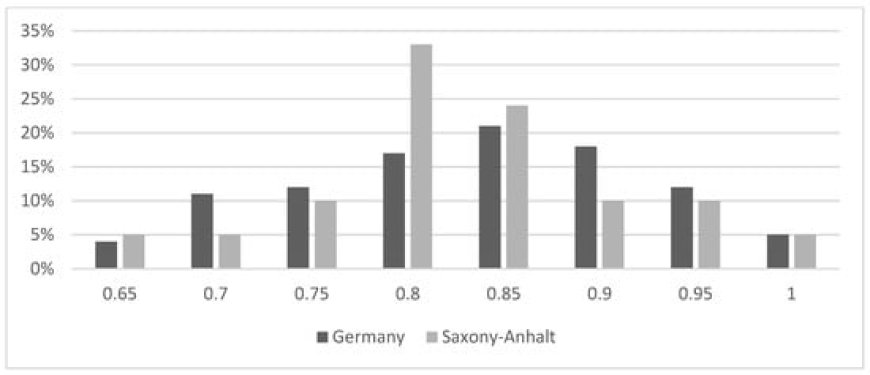
The objective of this study is to analyse the effects of attended school type and class level on the reported caries experience (DMFT) obtained in the serial cross-sectional National Oral Health Study in Children in Germany (NOHSC) for the WHO reference group of 12-year-olds. Methods: Caries data from the 2016 NOHSC were adjusted for each federal state on the basis of two additional large-scale datasets for school type and class level. Results: Twelve-year-olds in all grades in Saxony-Anhalt (n = 96,842) exhibited significantly higher DMFT values than 12-year-olds in 6th grade (n = 76,456; +0.10 DMFT; ~14.2%, p < 0.001). Adjustments for school type had effects on DMFT on the level of federal states but almost balanced out on the national level (−0.01 DMFT; ~2%). Due to putatively similar structures of the federal states, the national mean DMFT for 12-year-olds in the latest NOHSC (2016; n = 55,002) was adjusted from 0.44 to 0.50 DMFT, correcting for selection bias. Conclusion: Selection bias in this NOHSC leads to an underestimation of caries levels by about 15%. Due to very low caries experience in children in Germany, these precise adjustments (+0.06 DMFT) have only a minor effect on interpretations of the national epidemiologic situation. Consequently, other national caries studies worldwide using the robust marker of DMFT should also adjust for systematic selection bias related to socio-economic background rather than increasing efforts in examination strategy.
IJERPH, Vol. 21, Pages 467: Influence of School Type and Class Level on Mean Caries Experience in 12-Year-Olds in Serial Cross-Sectional National Oral Health Survey in Germany—Proposal to Adjust for Selection Bias
International Journal of Environmental Research and Public Health doi: 10.3390/ijerph21040467
Authors: Julian Schmoeckel Goetz Wahl Ruth M. Santamaría Roger Basner Elisabeth Schankath Christian H. Splieth
The objective of this study is to analyse the effects of attended school type and class level on the reported caries experience (DMFT) obtained in the serial cross-sectional National Oral Health Study in Children in Germany (NOHSC) for the WHO reference group of 12-year-olds. Methods: Caries data from the 2016 NOHSC were adjusted for each federal state on the basis of two additional large-scale datasets for school type and class level. Results: Twelve-year-olds in all grades in Saxony-Anhalt (n = 96,842) exhibited significantly higher DMFT values than 12-year-olds in 6th grade (n = 76,456; +0.10 DMFT; ~14.2%, p < 0.001). Adjustments for school type had effects on DMFT on the level of federal states but almost balanced out on the national level (−0.01 DMFT; ~2%). Due to putatively similar structures of the federal states, the national mean DMFT for 12-year-olds in the latest NOHSC (2016; n = 55,002) was adjusted from 0.44 to 0.50 DMFT, correcting for selection bias. Conclusion: Selection bias in this NOHSC leads to an underestimation of caries levels by about 15%. Due to very low caries experience in children in Germany, these precise adjustments (+0.06 DMFT) have only a minor effect on interpretations of the national epidemiologic situation. Consequently, other national caries studies worldwide using the robust marker of DMFT should also adjust for systematic selection bias related to socio-economic background rather than increasing efforts in examination strategy.
What's Your Reaction?