IJERPH, Vol. 21, Pages 439: Impact of Shiftwork on Retinal Vasculature Diameters over a 5-Year Period: A Preliminary Investigation Using the BCOPS Study Data
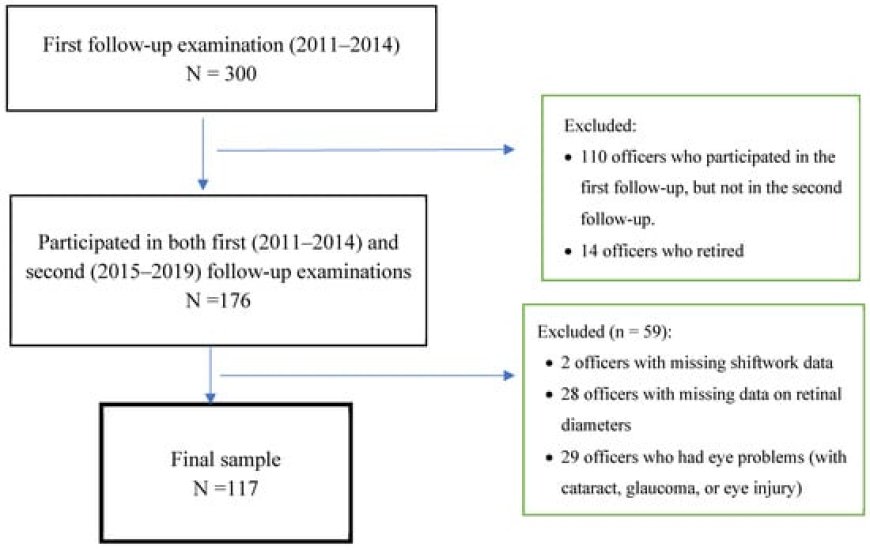
Our aim was to investigate the impact of shiftwork on changes in central retinal arteriolar equivalent (CRAE), a measure of arteriolar width, and central retinal venular equivalent (CRVE), a measure of venular width, over five years. The participants were 117 officers (72.7% men) examined at the first (2011–2014) and second (2015–2019) follow-up examinations in the Buffalo Cardio-Metabolic Occupational Police Stress study. Shiftwork data were obtained from the City of Buffalo, NY payroll records. Retinal diameters were measured using a standardized protocol. ANCOVA was used to compare mean change in CRAE and CRVE between the two examinations across shiftwork categories. Among men only, those who worked ≥70% hours on day shifts had a larger decrease in mean CRAE (−7.13 µm ± 2.51) compared to those who worked
IJERPH, Vol. 21, Pages 439: Impact of Shiftwork on Retinal Vasculature Diameters over a 5-Year Period: A Preliminary Investigation Using the BCOPS Study Data
International Journal of Environmental Research and Public Health doi: 10.3390/ijerph21040439
Authors: Luenda E. Charles Ja K. Gu John M. Violanti
Our aim was to investigate the impact of shiftwork on changes in central retinal arteriolar equivalent (CRAE), a measure of arteriolar width, and central retinal venular equivalent (CRVE), a measure of venular width, over five years. The participants were 117 officers (72.7% men) examined at the first (2011–2014) and second (2015–2019) follow-up examinations in the Buffalo Cardio-Metabolic Occupational Police Stress study. Shiftwork data were obtained from the City of Buffalo, NY payroll records. Retinal diameters were measured using a standardized protocol. ANCOVA was used to compare mean change in CRAE and CRVE between the two examinations across shiftwork categories. Among men only, those who worked ≥70% hours on day shifts had a larger decrease in mean CRAE (−7.13 µm ± 2.51) compared to those who worked <70% day (−0.08 ± 0.96; p = 0.011). Among patrol officers, those who worked ≥70% day had a larger decrease in CRAE compared to those who worked <70% day (p = 0.015). Also, officers who worked ≥70% day had an increase in mean CRVE (µm) (4.56 ± 2.56) compared to those who worked <70% (−2.32 ± 1.32; p = 0.027). Over the five-year period, we observed adverse changes in arteriolar and venular diameters among officers who worked ≥70% on day shifts. The results should be interpreted with caution due to the small sample sizes.
What's Your Reaction?