IJERPH, Vol. 21, Pages 429: Developmental Trajectories of Cyber-Aggression among Early Adolescents in Canada: The Impact of Aggression, Gender, and Time Spent Online
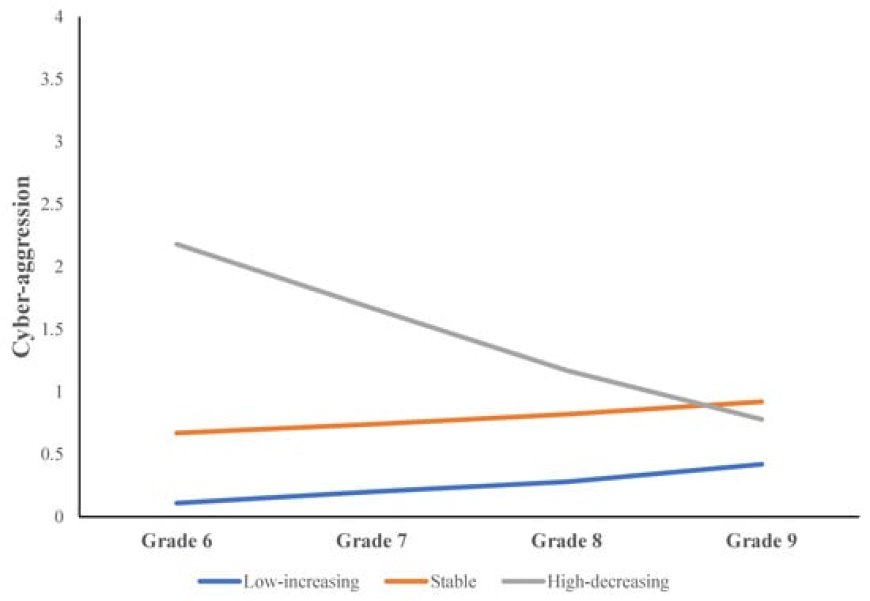
The objective of the present study was to examine developmental trajectories of cyber-aggression in early adolescence, as well as their relationship with predictive factors related to cyber-aggression (e.g., overt aggression, gender, and time spent online). Participants were 384 adolescents from the Lower Mainland of British Columbia, Canada who were in grade six and grade seven at Time 1 of the study (192 boys, Mage = 13.62 years, SD = 0.74 year). Three years of longitudinal data on cyber-aggression, overt aggression, and time spent online were collected via online self-report questionnaires. Findings indicated three different trajectories of cyber-aggression: (a) a low-increasing (85.7% of the sample), (b) a stable trajectory (9.3% of the sample), and (c) a high-decreasing trajectory (4.9% of the sample). Adolescents who reported higher scores on overt aggression and spent more time online were more likely to be in the stable or high-decreasing groups. These findings highlight the importance of studying subgroups regarding the developmental course of cyber-aggression in early adolescence. The implications of present study findings give insight into gender differences and overt aggression among youth to inform cyber-aggression intervention and prevention.
IJERPH, Vol. 21, Pages 429: Developmental Trajectories of Cyber-Aggression among Early Adolescents in Canada: The Impact of Aggression, Gender, and Time Spent Online
International Journal of Environmental Research and Public Health doi: 10.3390/ijerph21040429
Authors: Bowen Xiao Natasha Parent Takara Bond Johanna Sam Jennifer Shapka
The objective of the present study was to examine developmental trajectories of cyber-aggression in early adolescence, as well as their relationship with predictive factors related to cyber-aggression (e.g., overt aggression, gender, and time spent online). Participants were 384 adolescents from the Lower Mainland of British Columbia, Canada who were in grade six and grade seven at Time 1 of the study (192 boys, Mage = 13.62 years, SD = 0.74 year). Three years of longitudinal data on cyber-aggression, overt aggression, and time spent online were collected via online self-report questionnaires. Findings indicated three different trajectories of cyber-aggression: (a) a low-increasing (85.7% of the sample), (b) a stable trajectory (9.3% of the sample), and (c) a high-decreasing trajectory (4.9% of the sample). Adolescents who reported higher scores on overt aggression and spent more time online were more likely to be in the stable or high-decreasing groups. These findings highlight the importance of studying subgroups regarding the developmental course of cyber-aggression in early adolescence. The implications of present study findings give insight into gender differences and overt aggression among youth to inform cyber-aggression intervention and prevention.
What's Your Reaction?