Foods, Vol. 13, Pages 1295: Effects of Different Drying Methods on Drying Characteristics, Microstructure, Quality, and Energy Consumption of Apricot Slices
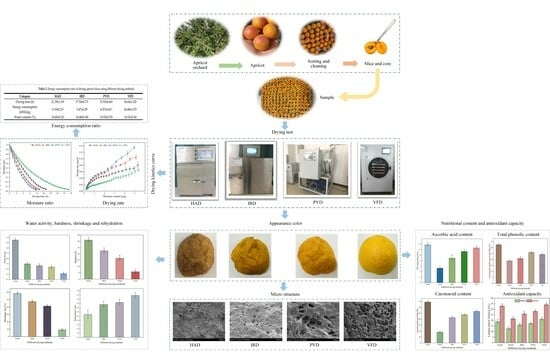
An appropriate drying method is crucial for producing high-quality dried apricots. In this study, the effects of four drying methods, hot air drying (HAD), infrared drying (IRD), pulse vacuum drying (PVD), and vacuum freeze-drying (VFD), on the drying kinetics and physical and nutritional characteristics of apricot slices were evaluated. PVD required the shortest time (16.25 h), followed by IRD (17.54 h), HAD (21.39 h), and VFD (34.64 h). VFD resulted in the best quality of apricot slices, with the smallest color difference (ΔE = 13.64), lowest water activity (0.312 ± 0.015) and browning degree (0.35), highest color saturation (62.84), lowest hardness (8.35 ± 0.47 N) and shrinkage (9.13 ± 0.65%), strongest rehydration ability (3.58 ± 0.11 g/g), a good microstructure, and high nutrient-retention rates (ascorbic acid content: 53.31 ± 0.58 mg/100 g, total phenolic content: 12.64 ± 0.50 mg GAE/g, and carotenoid content: 24.23 ± 0.58 mg/100 g) and antioxidant activity (DPPH: 21.10 ± 0.99 mmol Trolox/g and FRAP: 34.10 ± 0.81 mmol Trolox/g). The quality of PVD-treated apricot slices was second-best, and the quality of HAD-treated apricot slices was the worst. However, the energy consumption required for VFD was relatively high, while that required for PVD was lower. The results of this study provide a scientific basis for the large-scale industrial production of dried apricots.
Foods, Vol. 13, Pages 1295: Effects of Different Drying Methods on Drying Characteristics, Microstructure, Quality, and Energy Consumption of Apricot Slices
Foods doi: 10.3390/foods13091295
Authors: Qiaonan Yang Xiaokang Yi Hongwei Xiao Xufeng Wang Lin Liu Ziya Tang Can Hu Xibing Li
An appropriate drying method is crucial for producing high-quality dried apricots. In this study, the effects of four drying methods, hot air drying (HAD), infrared drying (IRD), pulse vacuum drying (PVD), and vacuum freeze-drying (VFD), on the drying kinetics and physical and nutritional characteristics of apricot slices were evaluated. PVD required the shortest time (16.25 h), followed by IRD (17.54 h), HAD (21.39 h), and VFD (34.64 h). VFD resulted in the best quality of apricot slices, with the smallest color difference (ΔE = 13.64), lowest water activity (0.312 ± 0.015) and browning degree (0.35), highest color saturation (62.84), lowest hardness (8.35 ± 0.47 N) and shrinkage (9.13 ± 0.65%), strongest rehydration ability (3.58 ± 0.11 g/g), a good microstructure, and high nutrient-retention rates (ascorbic acid content: 53.31 ± 0.58 mg/100 g, total phenolic content: 12.64 ± 0.50 mg GAE/g, and carotenoid content: 24.23 ± 0.58 mg/100 g) and antioxidant activity (DPPH: 21.10 ± 0.99 mmol Trolox/g and FRAP: 34.10 ± 0.81 mmol Trolox/g). The quality of PVD-treated apricot slices was second-best, and the quality of HAD-treated apricot slices was the worst. However, the energy consumption required for VFD was relatively high, while that required for PVD was lower. The results of this study provide a scientific basis for the large-scale industrial production of dried apricots.
What's Your Reaction?