Environments, Vol. 11, Pages 74: Effects of Sampling Time and Depth on Phytoplankton Metrics in Agricultural Irrigation Ponds
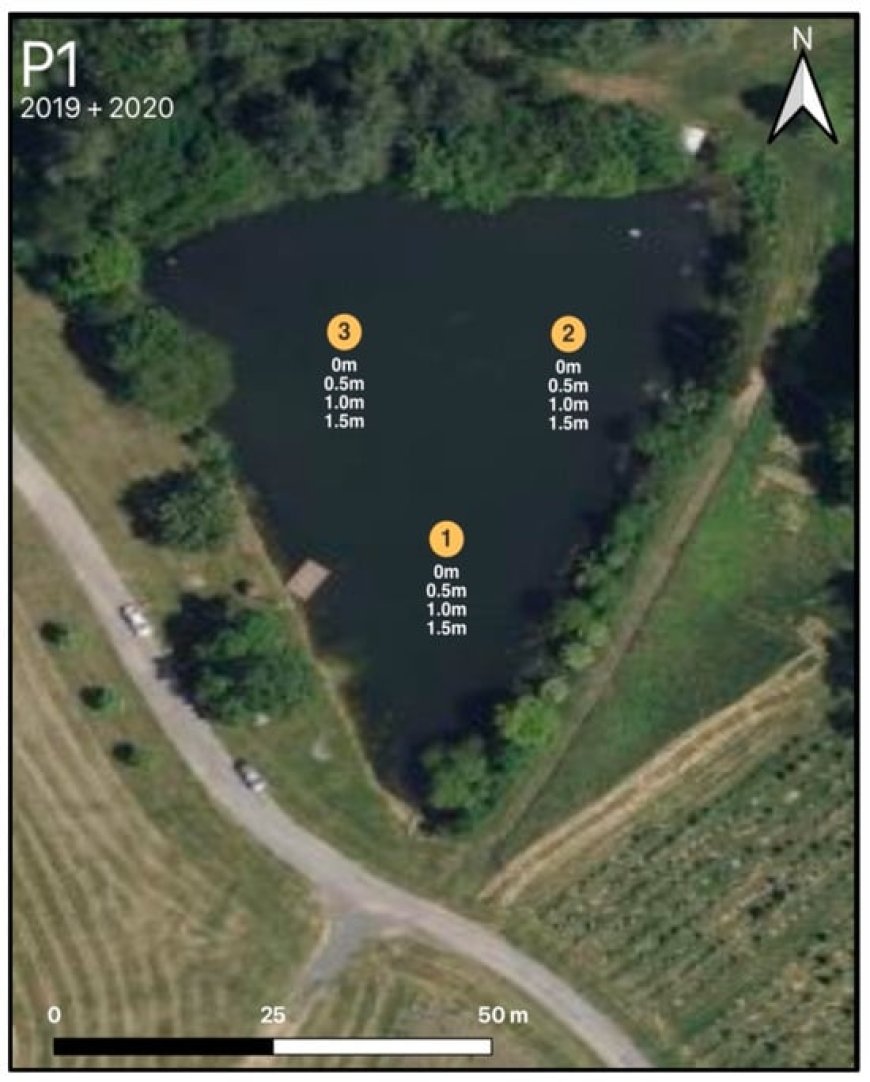
Spatiotemporal variations of phytoplankton populations in agricultural irrigation ponds need to be accounted for in order to properly assess water quality. Phytoplankton cell and photosynthetic pigment concentrations are two common metrics used to characterize phytoplankton communities. This work evaluated depth and time of the day as factors affecting discrete sampling of phytoplankton. The abundance of chlorophytes, diatoms, cyanobacteria, flagellates, and dinoflagellates, as well as chlorophyll-a and phycocyanin pigments, were determined in samples taken at the surface and depth, in 0.5 m increments, in three to five spatial replications at 9 a.m., 12 p.m., and 3 p.m. in two ponds in Maryland, USA. Depth was a significant factor for photosynthetic pigment concentration variations in both ponds on most sampling dates and time of day was a significant factor for photosynthetic pigment concentrations in half of the sampling dates. Depth was not a significant factor in cell concentration variations for any of the phytoplankton groups observed, but time of day was a significant factor in 40% of the sampling dates. Two distinct patterns in pigment concentration daily variation were observed. The first featured a continuous increase with depth throughout the day. The second showed maximum concentrations at the surface in the morning changing to maximum concentrations at 0.5 m depth at 12 p.m. and 3 p.m.; these patterns corresponded to different morning solar irradiance levels. This indicates that sampling depth and time can be a significant factor when evaluating photosynthetic pigments and should be accounted for in monitoring programs that rely on pigments for decision-making.
Environments, Vol. 11, Pages 74: Effects of Sampling Time and Depth on Phytoplankton Metrics in Agricultural Irrigation Ponds
Environments doi: 10.3390/environments11040074
Authors: Jaclyn E. Smith Jennifer L. Wolny Matthew D. Stocker Yakov Pachepsky
Spatiotemporal variations of phytoplankton populations in agricultural irrigation ponds need to be accounted for in order to properly assess water quality. Phytoplankton cell and photosynthetic pigment concentrations are two common metrics used to characterize phytoplankton communities. This work evaluated depth and time of the day as factors affecting discrete sampling of phytoplankton. The abundance of chlorophytes, diatoms, cyanobacteria, flagellates, and dinoflagellates, as well as chlorophyll-a and phycocyanin pigments, were determined in samples taken at the surface and depth, in 0.5 m increments, in three to five spatial replications at 9 a.m., 12 p.m., and 3 p.m. in two ponds in Maryland, USA. Depth was a significant factor for photosynthetic pigment concentration variations in both ponds on most sampling dates and time of day was a significant factor for photosynthetic pigment concentrations in half of the sampling dates. Depth was not a significant factor in cell concentration variations for any of the phytoplankton groups observed, but time of day was a significant factor in 40% of the sampling dates. Two distinct patterns in pigment concentration daily variation were observed. The first featured a continuous increase with depth throughout the day. The second showed maximum concentrations at the surface in the morning changing to maximum concentrations at 0.5 m depth at 12 p.m. and 3 p.m.; these patterns corresponded to different morning solar irradiance levels. This indicates that sampling depth and time can be a significant factor when evaluating photosynthetic pigments and should be accounted for in monitoring programs that rely on pigments for decision-making.
What's Your Reaction?