Environments, Vol. 11, Pages 50: Development of Cellulose Air Filters for Capturing Fine and Ultrafine Particles through the Valorization of Banana Cultivation Biomass Waste
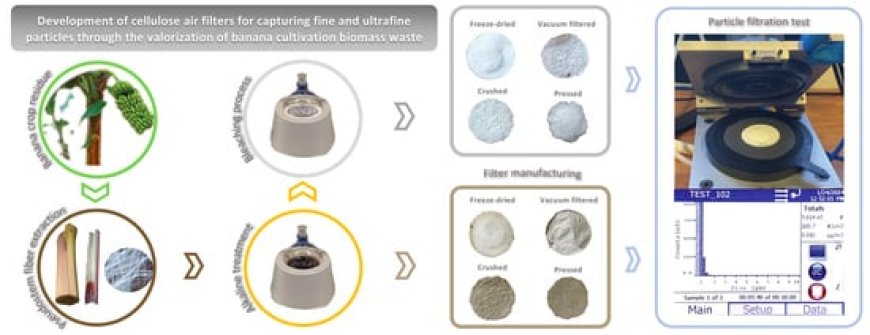
Outdoor and indoor atmospheric pollution is one of the major problems that humanity continues to face. As a mitigation pathway, numerous technologies have been developed for air purification, including the use of fibrous filters. In this study, the particle capture efficiencies and pressure drops of air filters manufactured with cellulose pulp extracted from banana pseudostems were studied across three particle size ranges (PM10, PM2.5, and PM1). Two pretreatments were applied, alkaline with soda-antraquinone (alkali-treated pulp) and a subsequent bleaching process (bleached pulp), and four manufacturing processes were tested: crushing, freeze-drying, vacuum filtration, and pressing. In addition, a study varying filter grammage (70, 100, and 160 g·m−2) and pressing pressures (2, 4, 6, and 8 t) was also performed. After conducting these particle tests, the filter manufactured with bleached pulp, having a grammage of 160 g·m−2 and pressed at 4 t, was deemed the optimal individual solution. It demonstrated high particle retention efficiencies across all particle size ranges (with values exceeding 80%), a moderate pressure drop below 1000 Pa, and high thermal stability (degradation above 220 °C). However, combining freeze-drying and two-ton pressing processes yielded improved results (83% for the smallest particles and 89% for others) with approximately half the pressure drop. Based on these results, this study stands as a noteworthy contribution to waste valorization and the advancement of environmentally friendly materials for particle air filters. This is achieved through the adoption of simple and cost-effective technology, coupled with the utilization of 100% natural agricultural waste as the primary manufacturing material.
Environments, Vol. 11, Pages 50: Development of Cellulose Air Filters for Capturing Fine and Ultrafine Particles through the Valorization of Banana Cultivation Biomass Waste
Environments doi: 10.3390/environments11030050
Authors: Yumara Martín-Cruz Pablo Bordón Elisenda Pulido-Melián Teresa Saura-Cayuela Mario Monzón
Outdoor and indoor atmospheric pollution is one of the major problems that humanity continues to face. As a mitigation pathway, numerous technologies have been developed for air purification, including the use of fibrous filters. In this study, the particle capture efficiencies and pressure drops of air filters manufactured with cellulose pulp extracted from banana pseudostems were studied across three particle size ranges (PM10, PM2.5, and PM1). Two pretreatments were applied, alkaline with soda-antraquinone (alkali-treated pulp) and a subsequent bleaching process (bleached pulp), and four manufacturing processes were tested: crushing, freeze-drying, vacuum filtration, and pressing. In addition, a study varying filter grammage (70, 100, and 160 g·m−2) and pressing pressures (2, 4, 6, and 8 t) was also performed. After conducting these particle tests, the filter manufactured with bleached pulp, having a grammage of 160 g·m−2 and pressed at 4 t, was deemed the optimal individual solution. It demonstrated high particle retention efficiencies across all particle size ranges (with values exceeding 80%), a moderate pressure drop below 1000 Pa, and high thermal stability (degradation above 220 °C). However, combining freeze-drying and two-ton pressing processes yielded improved results (83% for the smallest particles and 89% for others) with approximately half the pressure drop. Based on these results, this study stands as a noteworthy contribution to waste valorization and the advancement of environmentally friendly materials for particle air filters. This is achieved through the adoption of simple and cost-effective technology, coupled with the utilization of 100% natural agricultural waste as the primary manufacturing material.
What's Your Reaction?