Environments, Vol. 10, Pages 213: Environmental Impact Assessment of Plastic Waste Management Scenarios in the Canadian Context
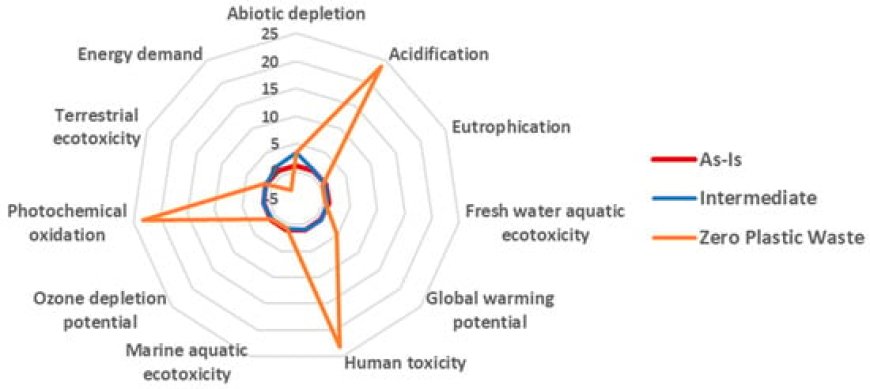
Given the scale of plastic generation, its persistent presence in the environment, and the urgent need to transition to a net-zero emissions paradigm, managing plastic waste has gained increasing attention globally. Developing an effective strategy for plastic waste management requires a comprehensive assessment of the potential benefits offered by different solutions, particularly with respect to their environmental impact. This study employs the life cycle assessment (LCA) methodology to evaluate the environmental impact of two alternative scenarios to the As-Is scenario for managing plastic waste in the province of British Columbia in Canada. The LCA results suggest that the Zero Plastic Waste scenario, which heavily relies on chemical recycling, may not inherently result in a reduced environmental footprint across all impact categories. This is notable when the focus is solely on end-of-life treatment processes, without considering the produced products and energy. The Intermediate scenario reduces the amount of plastic waste sent to landfills by directing more end-of-life plastic to mechanical recycling facilities. This scenario provides immediate benefits for resource conservation, with a minimal increase in the environmental burden resulting from treatment processes. Nonetheless, achieving a net-zero transition requires combining traditional and emerging recycling technologies. The current study could offer some guidance to policymakers on strategies for fostering more sustainable management of plastic waste.
Environments, Vol. 10, Pages 213: Environmental Impact Assessment of Plastic Waste Management Scenarios in the Canadian Context
Environments doi: 10.3390/environments10120213
Authors: Ophela Zhang Mahdi Takaffoli Myriam Ertz Walid Addar
Given the scale of plastic generation, its persistent presence in the environment, and the urgent need to transition to a net-zero emissions paradigm, managing plastic waste has gained increasing attention globally. Developing an effective strategy for plastic waste management requires a comprehensive assessment of the potential benefits offered by different solutions, particularly with respect to their environmental impact. This study employs the life cycle assessment (LCA) methodology to evaluate the environmental impact of two alternative scenarios to the As-Is scenario for managing plastic waste in the province of British Columbia in Canada. The LCA results suggest that the Zero Plastic Waste scenario, which heavily relies on chemical recycling, may not inherently result in a reduced environmental footprint across all impact categories. This is notable when the focus is solely on end-of-life treatment processes, without considering the produced products and energy. The Intermediate scenario reduces the amount of plastic waste sent to landfills by directing more end-of-life plastic to mechanical recycling facilities. This scenario provides immediate benefits for resource conservation, with a minimal increase in the environmental burden resulting from treatment processes. Nonetheless, achieving a net-zero transition requires combining traditional and emerging recycling technologies. The current study could offer some guidance to policymakers on strategies for fostering more sustainable management of plastic waste.
What's Your Reaction?