Climate, Vol. 12, Pages 99: Simulating Climatic Patterns and Their Impacts on the Food Security Stability System in Jammu, Kashmir and Adjoining Regions, India
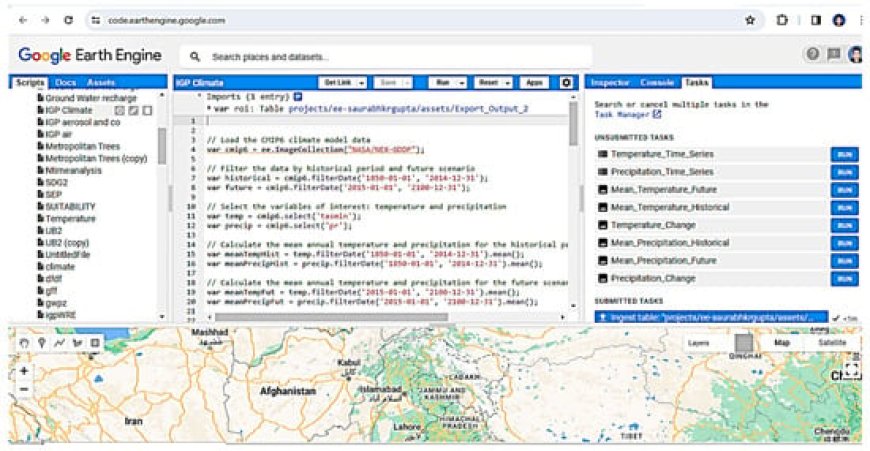
This study investigated the historical climate data and future projections under the SSP5-8.5 scenario for Jammu, Kashmir (J&K), and its adjoining regions in India. Agriculture is a critical economic pillar of this region, making it highly vulnerable to climate change. This study focused on temperature and precipitation trends. Statistical analysis and modeling methods, including cloud computing, were employed to predict changes and assess their impact on agricultural productivity and water resources. The results indicated that by 2100, the mean maximum and minimum temperatures are projected to increase by approximately 2.90 °C and 2.86 °C, respectively. Precipitation variability is expected to rise, with a mean increase of 2.64 × 10⁻⁶ mm per day. These changes have significant consequences for crop yield, water stress, and ecosystem dynamics. An analysis of Gross Primary Productivity (GPP) as a proxy for agricultural productivity using linear regression revealed a concerning trend. Although the total GPP of the study area remained stable over time, it declined by −570 g yr−1 in 2010, coinciding with a 1 °C temperature rise. Projections based on the expected 3 °C temperature increase by 2100 suggest a total GPP loss of −2500 g yr−1. These findings highlight the urgent need for proactive adaptation measures, including sustainable agricultural practices, improved water management, and enhanced socioeconomic infrastructure, to mitigate the impact of climate change and ensure long-term resilience and food security in the region.
Climate, Vol. 12, Pages 99: Simulating Climatic Patterns and Their Impacts on the Food Security Stability System in Jammu, Kashmir and Adjoining Regions, India
Climate doi: 10.3390/cli12070099
Authors: Aaqib Bhat Saurabh Gupta Suraj Singh Gowhar Meraj Pankaj Kumar Shruti Kanga Saurabh Singh Bhartendu Sajan
This study investigated the historical climate data and future projections under the SSP5-8.5 scenario for Jammu, Kashmir (J&K), and its adjoining regions in India. Agriculture is a critical economic pillar of this region, making it highly vulnerable to climate change. This study focused on temperature and precipitation trends. Statistical analysis and modeling methods, including cloud computing, were employed to predict changes and assess their impact on agricultural productivity and water resources. The results indicated that by 2100, the mean maximum and minimum temperatures are projected to increase by approximately 2.90 °C and 2.86 °C, respectively. Precipitation variability is expected to rise, with a mean increase of 2.64 × 10⁻⁶ mm per day. These changes have significant consequences for crop yield, water stress, and ecosystem dynamics. An analysis of Gross Primary Productivity (GPP) as a proxy for agricultural productivity using linear regression revealed a concerning trend. Although the total GPP of the study area remained stable over time, it declined by −570 g yr−1 in 2010, coinciding with a 1 °C temperature rise. Projections based on the expected 3 °C temperature increase by 2100 suggest a total GPP loss of −2500 g yr−1. These findings highlight the urgent need for proactive adaptation measures, including sustainable agricultural practices, improved water management, and enhanced socioeconomic infrastructure, to mitigate the impact of climate change and ensure long-term resilience and food security in the region.
What's Your Reaction?