Climate, Vol. 12, Pages 9: Assessing Future Precipitation Patterns, Extremes and Variability in Major Nile Basin Cities: An Ensemble Approach with CORDEX CORE Regional Climate Models
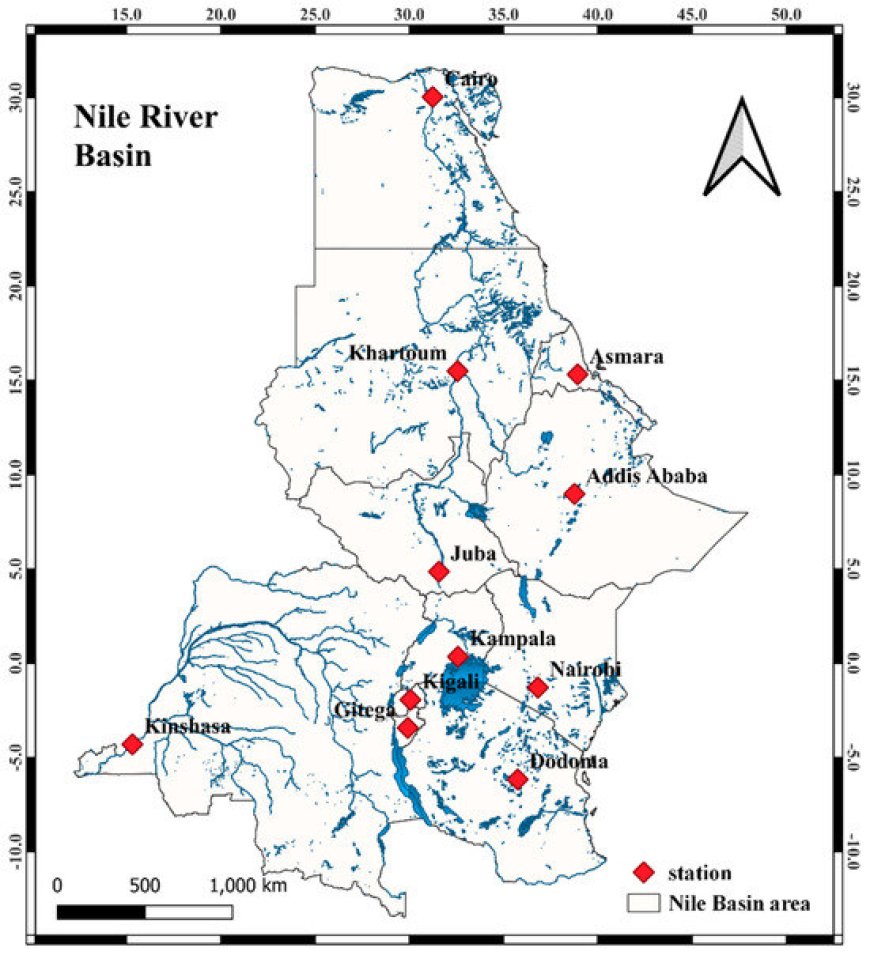
Understanding long-term variations in precipitation is crucial for identifying the effects of climate change and addressing hydrological and water management issues. This study examined the trends of the mean and four extreme precipitation indices, which are the max 1-day precipitation amount, the max 5-day precipitation amount, the consecutive wet days, and the consecutive dry days, for historical observations (1971–2000) and two future periods (2041–2060/2081–2100) under RCP2.6 and RCP8.5 emission scenarios over the Nile River Basin (NRB) at 11 major stations. Firstly, the empirical quantile mapping procedure significantly improved the performance of all RCMs, particularly those with lower performance, decreasing inter-model variability and enhanced seasonal precipitation variability. The Mann–Kendall test was used to detect the trends in climate extreme indices. This study reveals that precipitation changes vary across stations, scenarios, and time periods. Addis Ababa and Kigali anticipated a significant increase in precipitation across all periods and scenarios, ranging between 8–15% and 13–27%, respectively, while Cairo and Kinshasa exhibited a significant decrease in precipitation at around 90% and 38%, respectively. Wet (dry) spells were expected to significantly decrease (increase) over most parts of the NRB, especially during the second period (2081–2100). Thereby, the increase (decrease) in dry (wet) spells could have a direct impact on water resource availability in the NRB. This study also highlights that increased greenhouse gas emissions have a greater impact on precipitation patterns. This study’s findings might be useful to decision makers as they create NRB-wide mitigation and adaptation strategies to deal with the effects of climate change.
Climate, Vol. 12, Pages 9: Assessing Future Precipitation Patterns, Extremes and Variability in Major Nile Basin Cities: An Ensemble Approach with CORDEX CORE Regional Climate Models
Climate doi: 10.3390/cli12010009
Authors: Gamil Gamal Pavol Nejedlik Ahmed M. El Kenawy
Understanding long-term variations in precipitation is crucial for identifying the effects of climate change and addressing hydrological and water management issues. This study examined the trends of the mean and four extreme precipitation indices, which are the max 1-day precipitation amount, the max 5-day precipitation amount, the consecutive wet days, and the consecutive dry days, for historical observations (1971–2000) and two future periods (2041–2060/2081–2100) under RCP2.6 and RCP8.5 emission scenarios over the Nile River Basin (NRB) at 11 major stations. Firstly, the empirical quantile mapping procedure significantly improved the performance of all RCMs, particularly those with lower performance, decreasing inter-model variability and enhanced seasonal precipitation variability. The Mann–Kendall test was used to detect the trends in climate extreme indices. This study reveals that precipitation changes vary across stations, scenarios, and time periods. Addis Ababa and Kigali anticipated a significant increase in precipitation across all periods and scenarios, ranging between 8–15% and 13–27%, respectively, while Cairo and Kinshasa exhibited a significant decrease in precipitation at around 90% and 38%, respectively. Wet (dry) spells were expected to significantly decrease (increase) over most parts of the NRB, especially during the second period (2081–2100). Thereby, the increase (decrease) in dry (wet) spells could have a direct impact on water resource availability in the NRB. This study also highlights that increased greenhouse gas emissions have a greater impact on precipitation patterns. This study’s findings might be useful to decision makers as they create NRB-wide mitigation and adaptation strategies to deal with the effects of climate change.
What's Your Reaction?