Climate, Vol. 12, Pages 8: Climatology of Synoptic Non-Gaussian Meteorological Anomalies in the Northern Hemisphere during 1979–2018
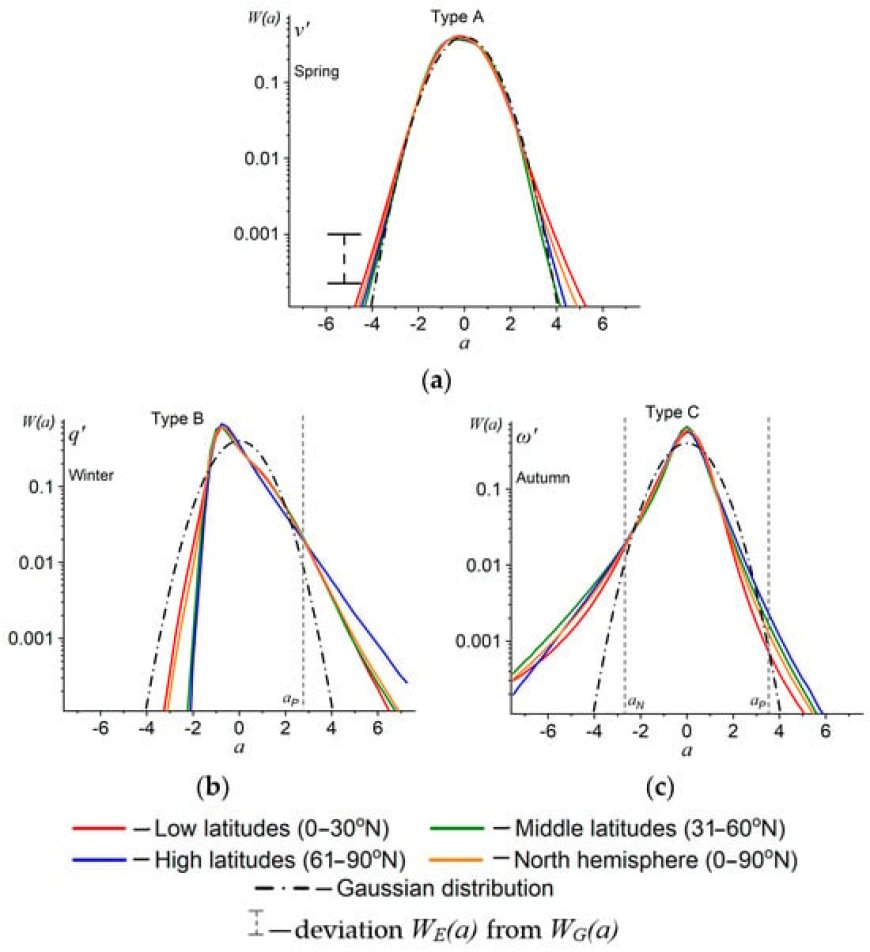
The analysis of spatial and temporal variability in the number of non-Gaussian extreme anomalies of climatic parameters was carried out for both the initial time series and synoptic variability in the troposphere of the Northern Hemisphere over the period 1979–2018, based on ERA-Interim reanalysis data. There are predominantly three types of empirical distribution densities at 850 hPa, each characterizing the processes of advective and convective heat transfer. At the beginning of the 21st century, compared to the end of the 20th century, there was an increase in the number of anomalies in vertical wind speed and specific humidity for the Northern Hemisphere. Additionally, there is an increase in the number of zonal wind speed anomalies in the low and middle latitudes. Regions with the maximum number of anomalies are primarily located over the continents, while for vertical wind speed anomalies, they are predominantly over the oceans. The application of R/S analysis and multifractal analysis has established that the identified tendencies (which are persistent processes) will continue in the identified regions. The time series of non-Gaussian anomalies (both initial and synoptic scales) exhibit a long-term memory of approximately four years, and synoptic extreme anomalies were found to be more predictable.
Climate, Vol. 12, Pages 8: Climatology of Synoptic Non-Gaussian Meteorological Anomalies in the Northern Hemisphere during 1979–2018
Climate doi: 10.3390/cli12010008
Authors: Sergey Loginov Evgeniia Moraru Elena Kharyutkina Ivan Sudakow
The analysis of spatial and temporal variability in the number of non-Gaussian extreme anomalies of climatic parameters was carried out for both the initial time series and synoptic variability in the troposphere of the Northern Hemisphere over the period 1979–2018, based on ERA-Interim reanalysis data. There are predominantly three types of empirical distribution densities at 850 hPa, each characterizing the processes of advective and convective heat transfer. At the beginning of the 21st century, compared to the end of the 20th century, there was an increase in the number of anomalies in vertical wind speed and specific humidity for the Northern Hemisphere. Additionally, there is an increase in the number of zonal wind speed anomalies in the low and middle latitudes. Regions with the maximum number of anomalies are primarily located over the continents, while for vertical wind speed anomalies, they are predominantly over the oceans. The application of R/S analysis and multifractal analysis has established that the identified tendencies (which are persistent processes) will continue in the identified regions. The time series of non-Gaussian anomalies (both initial and synoptic scales) exhibit a long-term memory of approximately four years, and synoptic extreme anomalies were found to be more predictable.
What's Your Reaction?