Climate, Vol. 12, Pages 73: People’s Perception of Climate Change Impacts on Subtropical Climatic Region: A Case Study of Upper Indus, Pakistan
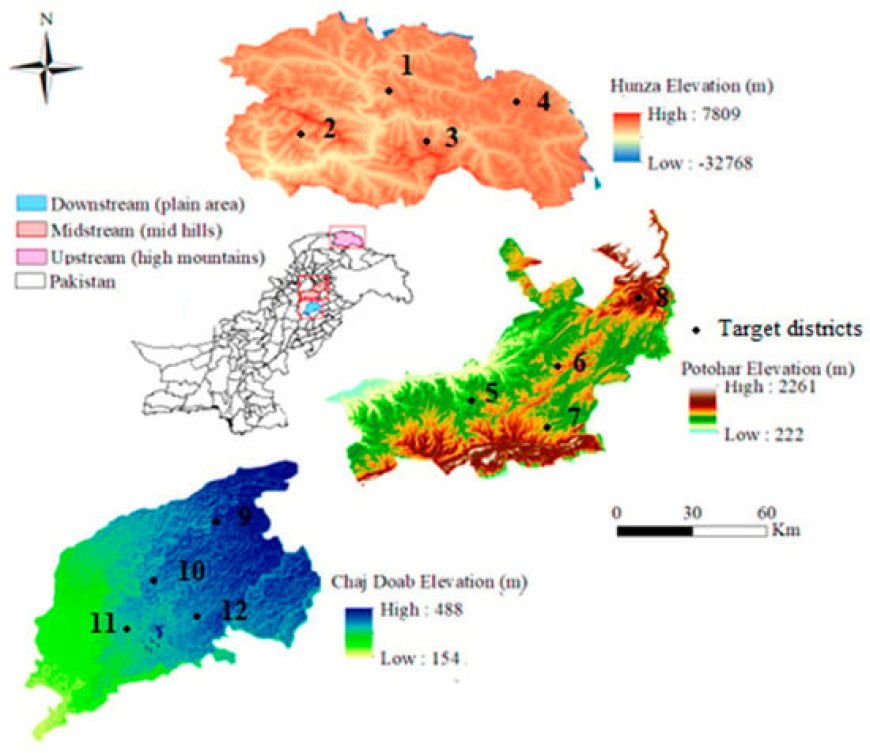
In developing countries like Pakistan, the preservation of the environment, as well as people’s economies, agriculture, and way of life, are believed to be hampered by climate change. Understanding how people perceive climate change and its signs is essential for creating a variety of adaptation solutions. In this study, we aim to bridge the gap in current research within this area, which predominantly relies on satellite data, by integrating qualitative assessments of people’s perceptions of climate change, thereby providing valuable ground-based observations of climate variability and its impacts on local communities. Field-based data were collected at different altitudes (upstream (US), midstream (MS), and downstream (DS)) of the Upper Indus Basin using both quantitative and qualitative assessments in 2017. The result shows that these altitudes are highly variable in many contexts: socioeconomic indicators of education, agriculture, income, women empowerment, health, access to basic resources, and livelihood diversifications are highly variable in the Indus Basin. The inhabitants of the Indus Basin perceive the climate changing around them and report impacts of this change as increase in overall temperatures (US 96.9%, MS 97%, DS 93.6%) and erratic rainfall patterns (US 44.1%, MS 73.3%, DS 51.0%) resulting in increased water availability for crops (US 38.6%, MS 39.7%, DS 54.8%) but also increasing number of dry days (US 56.7%, MS 85.5%, DS 67.1%). Communities at these altitudes said that agriculture was their primary source of income, making them particularly vulnerable to the effects of climate change and the dangers that go along with it. The insights are useful for determining what information and actions are required to support local climate-related hazard management in subtropical climate regions. Moreover, it is vital to launch a campaign to raise awareness of potential hazards, as well as to provide training and an early warning system.
Climate, Vol. 12, Pages 73: People’s Perception of Climate Change Impacts on Subtropical Climatic Region: A Case Study of Upper Indus, Pakistan
Climate doi: 10.3390/cli12050073
Authors: Bashir Ahmad Muhammad Umar Nadeem Saddam Hussain Abid Hussain Zeeshan Tahir Virik Khalid Jamil Nelufar Raza Ali Kamran Salar Saeed Dogar
In developing countries like Pakistan, the preservation of the environment, as well as people’s economies, agriculture, and way of life, are believed to be hampered by climate change. Understanding how people perceive climate change and its signs is essential for creating a variety of adaptation solutions. In this study, we aim to bridge the gap in current research within this area, which predominantly relies on satellite data, by integrating qualitative assessments of people’s perceptions of climate change, thereby providing valuable ground-based observations of climate variability and its impacts on local communities. Field-based data were collected at different altitudes (upstream (US), midstream (MS), and downstream (DS)) of the Upper Indus Basin using both quantitative and qualitative assessments in 2017. The result shows that these altitudes are highly variable in many contexts: socioeconomic indicators of education, agriculture, income, women empowerment, health, access to basic resources, and livelihood diversifications are highly variable in the Indus Basin. The inhabitants of the Indus Basin perceive the climate changing around them and report impacts of this change as increase in overall temperatures (US 96.9%, MS 97%, DS 93.6%) and erratic rainfall patterns (US 44.1%, MS 73.3%, DS 51.0%) resulting in increased water availability for crops (US 38.6%, MS 39.7%, DS 54.8%) but also increasing number of dry days (US 56.7%, MS 85.5%, DS 67.1%). Communities at these altitudes said that agriculture was their primary source of income, making them particularly vulnerable to the effects of climate change and the dangers that go along with it. The insights are useful for determining what information and actions are required to support local climate-related hazard management in subtropical climate regions. Moreover, it is vital to launch a campaign to raise awareness of potential hazards, as well as to provide training and an early warning system.
What's Your Reaction?