Climate, Vol. 12, Pages 48: Spatiotemporal Assessment of Surface Solar Dimming in India: Impacts of Multi-Level Clouds and Atmospheric Aerosols
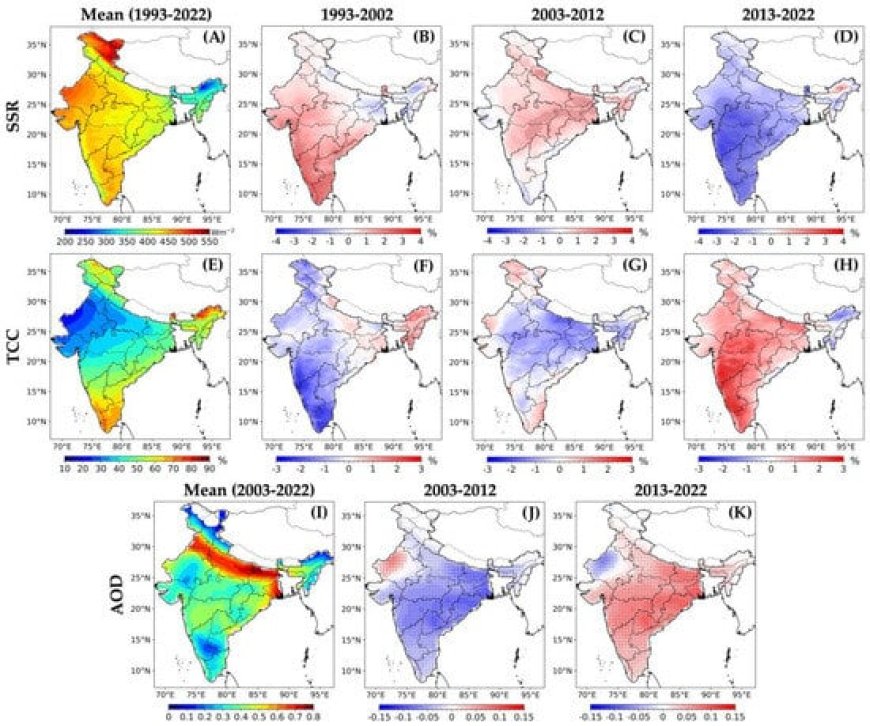
Surface solar radiation (SSR) is a fundamental energy source for an equitable and sustainable future. Meteorology-induced variability increases uncertainty in SSR, thereby limiting its reliability due to its intermittent nature. This variability depends on several meteorological factors, including clouds, atmospheric gases, and aerosol concentrations. This research investigates the detailed impact of different levels of clouds and aerosols on SSR across India. Utilizing satellite data with reanalysis retrievals, the research covers a span of three decades (30 years), from 1993 to 2022. Aerosols contributed to an average attenuation of ~13.33% on SSR, while high, mid, and low cloud conditions showed much stronger impacts, with an attenuation of ~30.80%, ~40.10%, and ~44.30%, respectively. This study reveals an alarming pattern of increasing cloud impact (Cimpact) on SSR in the recent decade, with a significant increasing rate of ~0.22% year−1 for high cloud (HCimpact) and ~0.13% year−1 for mid cloud (MCimpact) impact, while low cloud impact (LCimpact) showed minimal change. The trend of aerosol impact (Aimpact) also showed an average increase of ~0.14% year−1 across all regions. The findings underscore the imperative of considering climatic variables while studying the growing solar dimming. Our findings also will assist policymakers and planners in better evaluating the solar energy resources across India.
Climate, Vol. 12, Pages 48: Spatiotemporal Assessment of Surface Solar Dimming in India: Impacts of Multi-Level Clouds and Atmospheric Aerosols
Climate doi: 10.3390/cli12040048
Authors: Ashwin Vijay Jadhav P. R. C. Rahul Vinay Kumar Umesh Chandra Dumka Rohini L. Bhawar
Surface solar radiation (SSR) is a fundamental energy source for an equitable and sustainable future. Meteorology-induced variability increases uncertainty in SSR, thereby limiting its reliability due to its intermittent nature. This variability depends on several meteorological factors, including clouds, atmospheric gases, and aerosol concentrations. This research investigates the detailed impact of different levels of clouds and aerosols on SSR across India. Utilizing satellite data with reanalysis retrievals, the research covers a span of three decades (30 years), from 1993 to 2022. Aerosols contributed to an average attenuation of ~13.33% on SSR, while high, mid, and low cloud conditions showed much stronger impacts, with an attenuation of ~30.80%, ~40.10%, and ~44.30%, respectively. This study reveals an alarming pattern of increasing cloud impact (Cimpact) on SSR in the recent decade, with a significant increasing rate of ~0.22% year−1 for high cloud (HCimpact) and ~0.13% year−1 for mid cloud (MCimpact) impact, while low cloud impact (LCimpact) showed minimal change. The trend of aerosol impact (Aimpact) also showed an average increase of ~0.14% year−1 across all regions. The findings underscore the imperative of considering climatic variables while studying the growing solar dimming. Our findings also will assist policymakers and planners in better evaluating the solar energy resources across India.
What's Your Reaction?