Climate, Vol. 12, Pages 35: Global Solar Radiation and Its Interactions with Atmospheric Substances and Their Effects on Air Temperature Change in Ankara Province
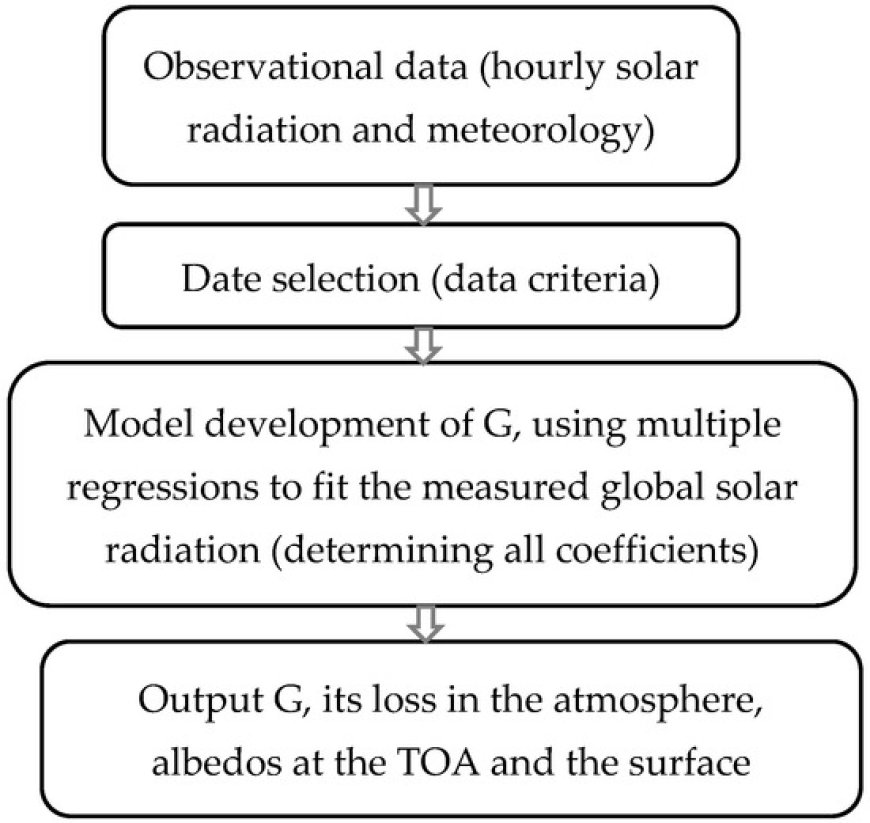
On the analysis of solar radiation and meteorological variables measured in Ankara province in Türkiye from 2017 to 2018, an empirical model of global solar radiation was developed. The global solar radiation at the ground and at the top of the atmosphere (TOA) was calculated and in good agreement with the observations. This model was applied to compute the losses of global solar radiation in the atmosphere and the contributions by atmospheric absorbing and scattering substances. The loss of global solar radiation in the atmosphere was dominated by the absorbing substances. The sensitivity test showed that global solar radiation was more sensitive to changes in scattering (described by a scattering factor S/G, S and G are diffuse and global solar radiation, respectively) than to changes in absorption. This empirical model was applied to calculate the albedos at the TOA and the surface. In 2017, 2018, and 2019, the computed albedos were 28.8%, 27.8%, and 28.2% at the TOA and 21.6%, 22.1%, and 21.9% at the surface, which were in reasonable agreement with satellite retrievals. The empirical model is a useful tool for studying global solar radiation and the multiple interactions between solar energy and atmospheric substances. The comparisons of global solar radiation and its loss in the atmosphere, as well as meteorological parameters, were made at some representative sites on the Earth. Some internal relationships (between G and the absorbing and scattering substances, air temperature and atmospheric substances, air temperature increase and latitude, etc.) were found. Thus, it is suggested to thoroughly study solar radiation, atmospheric substances, and climate change as a whole system and reduce the direct emissions of all atmospheric substances and, subsequently, secondary products (e.g., CO2 and non-CO2) in the atmosphere for the achievement of slowing down climate warming.
Climate, Vol. 12, Pages 35: Global Solar Radiation and Its Interactions with Atmospheric Substances and Their Effects on Air Temperature Change in Ankara Province
Climate doi: 10.3390/cli12030035
Authors: Jianhui Bai Xiaowei Wan Erhan Arslan Xuemei Zong
On the analysis of solar radiation and meteorological variables measured in Ankara province in Türkiye from 2017 to 2018, an empirical model of global solar radiation was developed. The global solar radiation at the ground and at the top of the atmosphere (TOA) was calculated and in good agreement with the observations. This model was applied to compute the losses of global solar radiation in the atmosphere and the contributions by atmospheric absorbing and scattering substances. The loss of global solar radiation in the atmosphere was dominated by the absorbing substances. The sensitivity test showed that global solar radiation was more sensitive to changes in scattering (described by a scattering factor S/G, S and G are diffuse and global solar radiation, respectively) than to changes in absorption. This empirical model was applied to calculate the albedos at the TOA and the surface. In 2017, 2018, and 2019, the computed albedos were 28.8%, 27.8%, and 28.2% at the TOA and 21.6%, 22.1%, and 21.9% at the surface, which were in reasonable agreement with satellite retrievals. The empirical model is a useful tool for studying global solar radiation and the multiple interactions between solar energy and atmospheric substances. The comparisons of global solar radiation and its loss in the atmosphere, as well as meteorological parameters, were made at some representative sites on the Earth. Some internal relationships (between G and the absorbing and scattering substances, air temperature and atmospheric substances, air temperature increase and latitude, etc.) were found. Thus, it is suggested to thoroughly study solar radiation, atmospheric substances, and climate change as a whole system and reduce the direct emissions of all atmospheric substances and, subsequently, secondary products (e.g., CO2 and non-CO2) in the atmosphere for the achievement of slowing down climate warming.
What's Your Reaction?