Foundations, Vol. 4, Pages 156-174: Exchangeable Quantities and Power Laws: Τhe Case of Pores in Solids
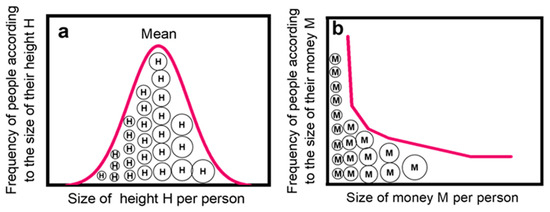
In this work we suggest that the common cause for the development of various power laws is the existence of a suitable exchangeable quantity between the agents of a set. Examples of such exchangeable quantities, leading to eponymous power laws, include money (Pareto’s Law), scientific knowledge (Lotka’s Law), people (Auerbach’s Law), and written or verbal information (Zipf’s Law), as well as less common cases like bullets during deadly conflicts, recognition in social networks, heat between the atmosphere and sea-ice floes, and, finally, mass of water vapors between pores in solids. This last case is examined closely in the present article based on extensive experimental data. It is shown that the transferred mass between pores, which eventually grow towards a power law distribution, may be expressed using different parameters, either transferred surface area, or transferred volume, or transferred pore length or transferred pore anisotropy. These distinctions lead to different power laws of variable strength as reflected by the corresponding exponent. The exponents depend quantitatively on the spread of frequency distribution of the examined parameter and tend to zero as the spread of distribution tends to a single order of magnitude. A comparison between the energy and the entropy of different kinds of pore distributions reveals that these two statistical parameters are linearly related, implying that the system poise at a critical state and the exchangeable quantities are the most convenient operations helping to keep this balance.
Foundations, Vol. 4, Pages 156-174: Exchangeable Quantities and Power Laws: Τhe Case of Pores in Solids
Foundations doi: 10.3390/foundations4020012
Authors: Antigoni G. Margellou Philippos J. Pomonis
In this work we suggest that the common cause for the development of various power laws is the existence of a suitable exchangeable quantity between the agents of a set. Examples of such exchangeable quantities, leading to eponymous power laws, include money (Pareto’s Law), scientific knowledge (Lotka’s Law), people (Auerbach’s Law), and written or verbal information (Zipf’s Law), as well as less common cases like bullets during deadly conflicts, recognition in social networks, heat between the atmosphere and sea-ice floes, and, finally, mass of water vapors between pores in solids. This last case is examined closely in the present article based on extensive experimental data. It is shown that the transferred mass between pores, which eventually grow towards a power law distribution, may be expressed using different parameters, either transferred surface area, or transferred volume, or transferred pore length or transferred pore anisotropy. These distinctions lead to different power laws of variable strength as reflected by the corresponding exponent. The exponents depend quantitatively on the spread of frequency distribution of the examined parameter and tend to zero as the spread of distribution tends to a single order of magnitude. A comparison between the energy and the entropy of different kinds of pore distributions reveals that these two statistical parameters are linearly related, implying that the system poise at a critical state and the exchangeable quantities are the most convenient operations helping to keep this balance.
What's Your Reaction?