Climate, Vol. 12, Pages 19: Evaluation of Bias-Corrected GCM CMIP6 Simulation of Sea Surface Temperature over the Gulf of Guinea
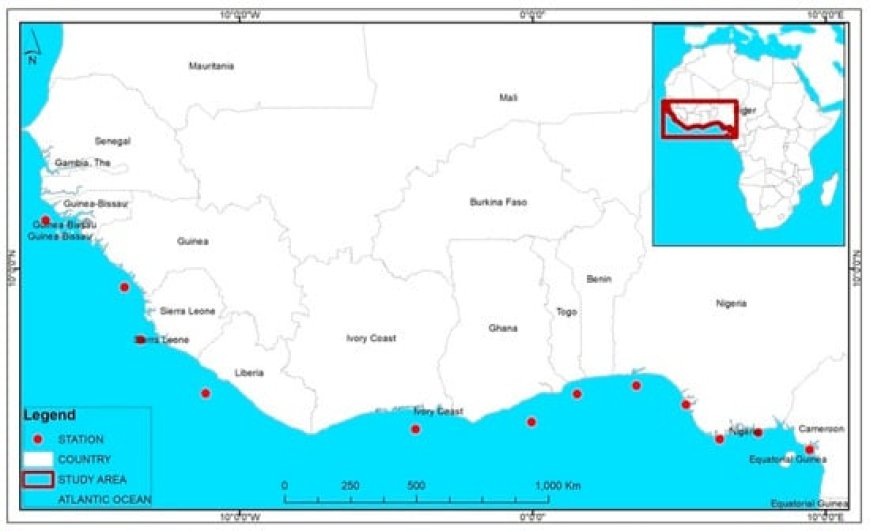
This study used an ERA5 reanalysis SST dataset re-gridded to a common grid with a 0.25° × 0.25° spatial resolution (latitude × longitude) for the historical (1940–2014) and projected (2015–2100) periods. The SST simulation under the SSP5-8.5 scenario was carried out with outputs from eight General Circulation Models (GCMs). The bias-corrected dataset was developed using Empirical Quantile Mapping (EQM) for the historical (1940–2015) and future (2030–2100) periods while the CMIP6 model simulation was evaluated against the ERA5 monthly observed reanalysis data for temperatures over the Gulf of Guinea. Overall, the CMIP6 models’ future simulations in 2030–20100 based on the SSP5-8.5 scenario indicate that SSTs are projected, for the Gulf of Guinea, to increase by 4.61 °C, from 31 °C in the coast in 2030 to 35 °C in 2100, and 2.6 °C in the Western GOG (Sahel). The Linux-based Ncview, Ferret, and the CDO (Climate Data Operator) software packages were used to perform further data re-gridding and assess statistical functions concerning the data. In addition, ArcGIS was used to develop output maps for visualizing the spatial trends of the historical and future outputs of the GCM. The correlation coefficient (r) was used to evaluate the performance of the CMIP6 models, and the analysis showed ACCESS 0.1, CAMS CSM 0.2, CAN ESM 0.3, CMCC 0.3, and MCM 0.4, indicating that all models performed well in capturing the climatological patterns of the SSTs. The CMIP6 bias-corrected model simulations showed that increased SST warming over the GOG will be higher in the far period than the near-term climate scenario. This study affirms that the CMIP6 projections can be used for multiple assessments related to climate and hydrological impact studies and for the development of mitigation measures under a warming climate.
Climate, Vol. 12, Pages 19: Evaluation of Bias-Corrected GCM CMIP6 Simulation of Sea Surface Temperature over the Gulf of Guinea
Climate doi: 10.3390/cli12020019
Authors: Oye Ideki Anthony R. Lupo
This study used an ERA5 reanalysis SST dataset re-gridded to a common grid with a 0.25° × 0.25° spatial resolution (latitude × longitude) for the historical (1940–2014) and projected (2015–2100) periods. The SST simulation under the SSP5-8.5 scenario was carried out with outputs from eight General Circulation Models (GCMs). The bias-corrected dataset was developed using Empirical Quantile Mapping (EQM) for the historical (1940–2015) and future (2030–2100) periods while the CMIP6 model simulation was evaluated against the ERA5 monthly observed reanalysis data for temperatures over the Gulf of Guinea. Overall, the CMIP6 models’ future simulations in 2030–20100 based on the SSP5-8.5 scenario indicate that SSTs are projected, for the Gulf of Guinea, to increase by 4.61 °C, from 31 °C in the coast in 2030 to 35 °C in 2100, and 2.6 °C in the Western GOG (Sahel). The Linux-based Ncview, Ferret, and the CDO (Climate Data Operator) software packages were used to perform further data re-gridding and assess statistical functions concerning the data. In addition, ArcGIS was used to develop output maps for visualizing the spatial trends of the historical and future outputs of the GCM. The correlation coefficient (r) was used to evaluate the performance of the CMIP6 models, and the analysis showed ACCESS 0.1, CAMS CSM 0.2, CAN ESM 0.3, CMCC 0.3, and MCM 0.4, indicating that all models performed well in capturing the climatological patterns of the SSTs. The CMIP6 bias-corrected model simulations showed that increased SST warming over the GOG will be higher in the far period than the near-term climate scenario. This study affirms that the CMIP6 projections can be used for multiple assessments related to climate and hydrological impact studies and for the development of mitigation measures under a warming climate.
What's Your Reaction?