Climate, Vol. 12, Pages 105: Unraveling the Intricate Links between the Dwindling Aral Sea and Climate Variability during 2002–2017
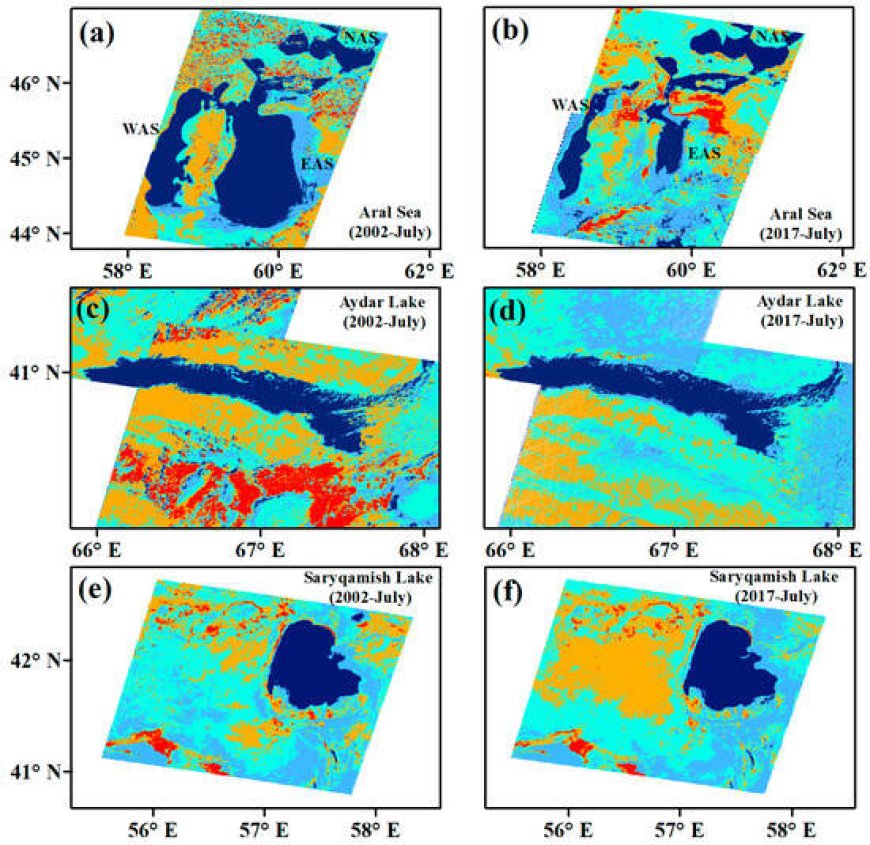
The Aral Sea is an indispensable component of the socio-economic progress of Central Asia but has undergone substantial ecological transformations over the last few decades, primarily due to global warming and human activities. Among these changes, the basin area has decreased, and water levels have dropped. This paper focuses on a comprehensive analysis of the spatial variation of key climate parameters, such as temperature, precipitation, and potential evapotranspiration over the Aral Sea. Moreover, we examined the transformation of seasonal water areas in the Aral Sea during the growing and non-growing seasons between 2002 and 2017 and the influence of climate and human factors on these changes using Landsat satellite data. Our results indicate that the western section of the Aral Sea has experienced a reduction in water area by 2.41 km2 and 1.83 km2 during the warm (R2 = 0.789) and cold (R2 = 0.744) seasons, respectively, over the investigated period. The decrease in lake water volume during the warm season can be attributed to local climate variations, as a strong negative correlation exists between seasonal water storage change and temperature (potential evapotranspiration). The correlation analysis shows that the water change in the northern part of the Aral Sea during the growing season has a significant positive correlation with temperature (R = 0.52) and an insignificant negative correlation with precipitation (R = −0.22). On the contrary, in the west and east parts of the Aral Sea, there is a significant negative correlation with temperature (R = −0.71 and −0.62) and a high positive correlation with precipitation (R = 0.71 and 0.55) during the growing season.
Climate, Vol. 12, Pages 105: Unraveling the Intricate Links between the Dwindling Aral Sea and Climate Variability during 2002–2017
Climate doi: 10.3390/cli12070105
Authors: Timur Berdimbetov Buddhi Pushpawela Nikita Murzintcev Sahibjamal Nietullaeva Khusen Gafforov Asiya Tureniyazova Dauranbek Madetov
The Aral Sea is an indispensable component of the socio-economic progress of Central Asia but has undergone substantial ecological transformations over the last few decades, primarily due to global warming and human activities. Among these changes, the basin area has decreased, and water levels have dropped. This paper focuses on a comprehensive analysis of the spatial variation of key climate parameters, such as temperature, precipitation, and potential evapotranspiration over the Aral Sea. Moreover, we examined the transformation of seasonal water areas in the Aral Sea during the growing and non-growing seasons between 2002 and 2017 and the influence of climate and human factors on these changes using Landsat satellite data. Our results indicate that the western section of the Aral Sea has experienced a reduction in water area by 2.41 km2 and 1.83 km2 during the warm (R2 = 0.789) and cold (R2 = 0.744) seasons, respectively, over the investigated period. The decrease in lake water volume during the warm season can be attributed to local climate variations, as a strong negative correlation exists between seasonal water storage change and temperature (potential evapotranspiration). The correlation analysis shows that the water change in the northern part of the Aral Sea during the growing season has a significant positive correlation with temperature (R = 0.52) and an insignificant negative correlation with precipitation (R = −0.22). On the contrary, in the west and east parts of the Aral Sea, there is a significant negative correlation with temperature (R = −0.71 and −0.62) and a high positive correlation with precipitation (R = 0.71 and 0.55) during the growing season.
What's Your Reaction?