Climate, Vol. 12, Pages 1: Equilibrium Climate after Spectral and Bolometric Irradiance Reduction in Grand Solar Minimum Simulations
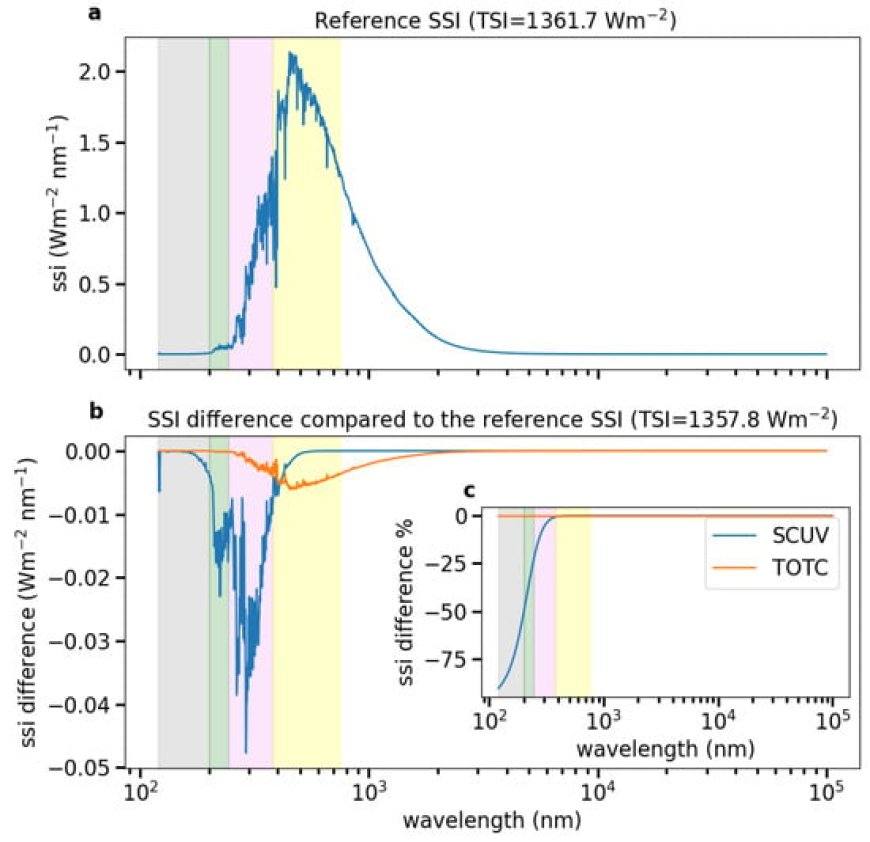
In this study, we use the Whole Atmosphere Community Climate Model, forced by present-day atmospheric composition and coupled to a Slab Ocean Model, to simulate the state of the climate under grand solar minimum forcing scenarios. Idealized experiments prescribe time-invariant solar irradiance reductions that are either uniform (percentage-wise) across the total solar radiation spectrum (TOTC) or spectrally localized in the ultraviolet (UV) band (SCUV). We compare the equilibrium condition of these experiments with the equilibrium condition of a control simulation, forced by perpetual solar maximum conditions. In SCUV, we observe large stratospheric cooling due to ozone reduction. In both the Northern Hemisphere (NH) and the Southern Hemisphere (SH), this is accompanied by a weakening of the polar night jet during the cold season. In TOTC, dynamically induced polar stratospheric cooling is observed in the transition seasons over the NH, without any ozone deficit. The global temperature cooling values, compared with the control climate, are 0.55±0.03 K in TOTC and 0.39±0.03 K in SCUV. The reductions in total meridional heat transport outside of the subtropics are similar in the two experiments, especially in the SH. Despite substantial differences in stratospheric forcing, similarities exist between the two experiments, such as cloudiness; meridional heating transport in the SH; and strong cooling in the NH during wintertime, although this cooling affects two different regions, namely, North America in TOTC and the Euro–Asian continent in SCUV.
Climate, Vol. 12, Pages 1: Equilibrium Climate after Spectral and Bolometric Irradiance Reduction in Grand Solar Minimum Simulations
Climate doi: 10.3390/cli12010001
Authors: Nazario Tartaglione Thomas Toniazzo Odd Helge Otterå Yvan Orsolini
In this study, we use the Whole Atmosphere Community Climate Model, forced by present-day atmospheric composition and coupled to a Slab Ocean Model, to simulate the state of the climate under grand solar minimum forcing scenarios. Idealized experiments prescribe time-invariant solar irradiance reductions that are either uniform (percentage-wise) across the total solar radiation spectrum (TOTC) or spectrally localized in the ultraviolet (UV) band (SCUV). We compare the equilibrium condition of these experiments with the equilibrium condition of a control simulation, forced by perpetual solar maximum conditions. In SCUV, we observe large stratospheric cooling due to ozone reduction. In both the Northern Hemisphere (NH) and the Southern Hemisphere (SH), this is accompanied by a weakening of the polar night jet during the cold season. In TOTC, dynamically induced polar stratospheric cooling is observed in the transition seasons over the NH, without any ozone deficit. The global temperature cooling values, compared with the control climate, are 0.55±0.03 K in TOTC and 0.39±0.03 K in SCUV. The reductions in total meridional heat transport outside of the subtropics are similar in the two experiments, especially in the SH. Despite substantial differences in stratospheric forcing, similarities exist between the two experiments, such as cloudiness; meridional heating transport in the SH; and strong cooling in the NH during wintertime, although this cooling affects two different regions, namely, North America in TOTC and the Euro–Asian continent in SCUV.
What's Your Reaction?