Climate, Vol. 11, Pages 222: Climate Risk and Vulnerability Assessment of Georgian Hydrology under Future Climate Change Scenarios
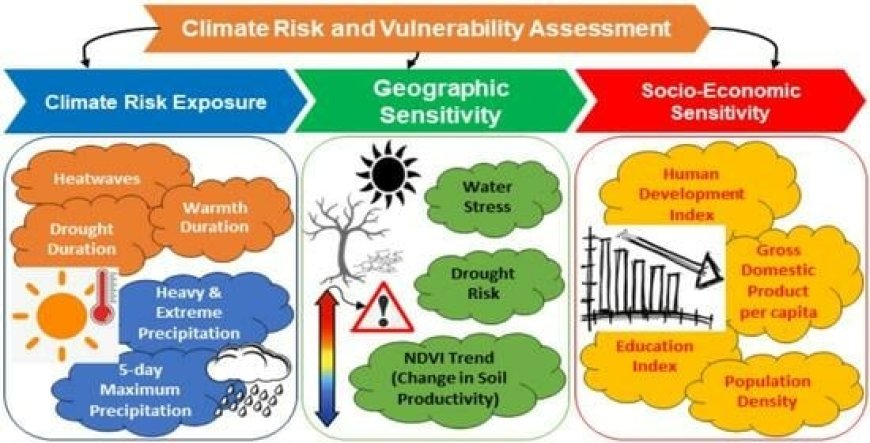
The Climate Risk and Vulnerability Assessment (CRVA) is a systematic process used to identify gaps in regional climate adaptation strategies. The CRVA method assesses regional vulnerability, adaptation capacity, exposure, and sensitivity to climate change to support improved adaptation policies. This CRVA study assesses Georgia’s climate exposure, geographic sensitivity, and socio-economic sensitivity by focusing on the impacts of climate change on regional hydrology. The projected change in climate extreme indices, defined by the Expert Team on Climate Change Detection and Indices (ETCCDI), is assessed against the 1961–1990 baseline under future Representative Concentration Pathway (RCP) scenarios. These indices encompass various climate factors such as the maximum daily temperature, warmth duration, total precipitation, heavy and extreme precipitation, maximum 5-day precipitation, and consecutive drought duration. This evaluation helps us understand the potential climate exposure impacts on Georgia. The climate-induced geographic sensitivity is examined based on water stress, drought risk, and changes in soil productivity using the Normalized Difference Vegetation Index (NDVI). The climate-induced socio-economic sensitivity is determined using the Gross Domestic Product per capita (GDP), Human Development Index, Education Index, and population density. The highest vulnerability to climate change was found in the Kakheti and Kvemo Kartli regions, with the vulnerability index values ranging from 6 to 15, followed by Mtskheta-Mtianeti, Samtskhe–Javakheti, and Shida Kartli with vulnerability index values ranging from 2 to 8. The location of these regions upstream of the Alazani-Iori, Khrami-Debeda, and Mktvari river basins indicates that the country’s water resources are vulnerable to climate change impacts in the future under the RCP 4.5 and 8.5 scenarios.
Climate, Vol. 11, Pages 222: Climate Risk and Vulnerability Assessment of Georgian Hydrology under Future Climate Change Scenarios
Climate doi: 10.3390/cli11110222
Authors: Aashutosh Aryal Rieks Bosch Venkataraman Lakshmi
The Climate Risk and Vulnerability Assessment (CRVA) is a systematic process used to identify gaps in regional climate adaptation strategies. The CRVA method assesses regional vulnerability, adaptation capacity, exposure, and sensitivity to climate change to support improved adaptation policies. This CRVA study assesses Georgia’s climate exposure, geographic sensitivity, and socio-economic sensitivity by focusing on the impacts of climate change on regional hydrology. The projected change in climate extreme indices, defined by the Expert Team on Climate Change Detection and Indices (ETCCDI), is assessed against the 1961–1990 baseline under future Representative Concentration Pathway (RCP) scenarios. These indices encompass various climate factors such as the maximum daily temperature, warmth duration, total precipitation, heavy and extreme precipitation, maximum 5-day precipitation, and consecutive drought duration. This evaluation helps us understand the potential climate exposure impacts on Georgia. The climate-induced geographic sensitivity is examined based on water stress, drought risk, and changes in soil productivity using the Normalized Difference Vegetation Index (NDVI). The climate-induced socio-economic sensitivity is determined using the Gross Domestic Product per capita (GDP), Human Development Index, Education Index, and population density. The highest vulnerability to climate change was found in the Kakheti and Kvemo Kartli regions, with the vulnerability index values ranging from 6 to 15, followed by Mtskheta-Mtianeti, Samtskhe–Javakheti, and Shida Kartli with vulnerability index values ranging from 2 to 8. The location of these regions upstream of the Alazani-Iori, Khrami-Debeda, and Mktvari river basins indicates that the country’s water resources are vulnerable to climate change impacts in the future under the RCP 4.5 and 8.5 scenarios.
What's Your Reaction?