CivilEng, Vol. 5, Pages 343-377: Energy-Based Design of Buckling-Restrained Steel Braced Frames for Concurrent Occurrences of Earthquake and Wind
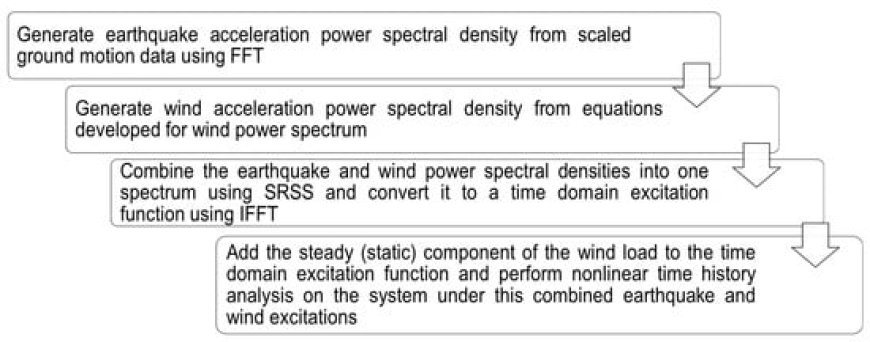
This paper describes the development of a dual hazard spectrum for use in the dynamic analysis of steel frames subject to the combined effects of earthquakes and wind. The proposed spectrum is obtained by combining the power spectra of earthquakes and wind using the square root of the sum of squares (SRSS) combination method. An equivalent time excitation function is then computed using an inverse fast Fourier transform (IFFT) and serves as input for the dynamic analysis. Using time-history analysis on the OpenSees platform, the dynamic responses expressed in terms of peak and residual inter-story and roof drifts for two multistory steel frames located in two US cities (Los Angeles and Charleston) are obtained to demonstrate that designing these buildings based on just one hazard may not be adequate. For frames that are considered under-designed, an energy-based design procedure that uses buckling-restrained braces (BRBs) to dissipate the excess energy imparted to these frames is proposed so they will satisfy the FEMA 356 recommended drift limits for the performance levels of immediate occupancy and life safety.
CivilEng, Vol. 5, Pages 343-377: Energy-Based Design of Buckling-Restrained Steel Braced Frames for Concurrent Occurrences of Earthquake and Wind
CivilEng doi: 10.3390/civileng5020018
Authors: Taonian Shan Eric M. Lui
This paper describes the development of a dual hazard spectrum for use in the dynamic analysis of steel frames subject to the combined effects of earthquakes and wind. The proposed spectrum is obtained by combining the power spectra of earthquakes and wind using the square root of the sum of squares (SRSS) combination method. An equivalent time excitation function is then computed using an inverse fast Fourier transform (IFFT) and serves as input for the dynamic analysis. Using time-history analysis on the OpenSees platform, the dynamic responses expressed in terms of peak and residual inter-story and roof drifts for two multistory steel frames located in two US cities (Los Angeles and Charleston) are obtained to demonstrate that designing these buildings based on just one hazard may not be adequate. For frames that are considered under-designed, an energy-based design procedure that uses buckling-restrained braces (BRBs) to dissipate the excess energy imparted to these frames is proposed so they will satisfy the FEMA 356 recommended drift limits for the performance levels of immediate occupancy and life safety.
What's Your Reaction?