CivilEng, Vol. 5, Pages 191-208: Ensuring Structural Integrity: An Evaluation of Vertical Shortening in Tall Concrete Buildings
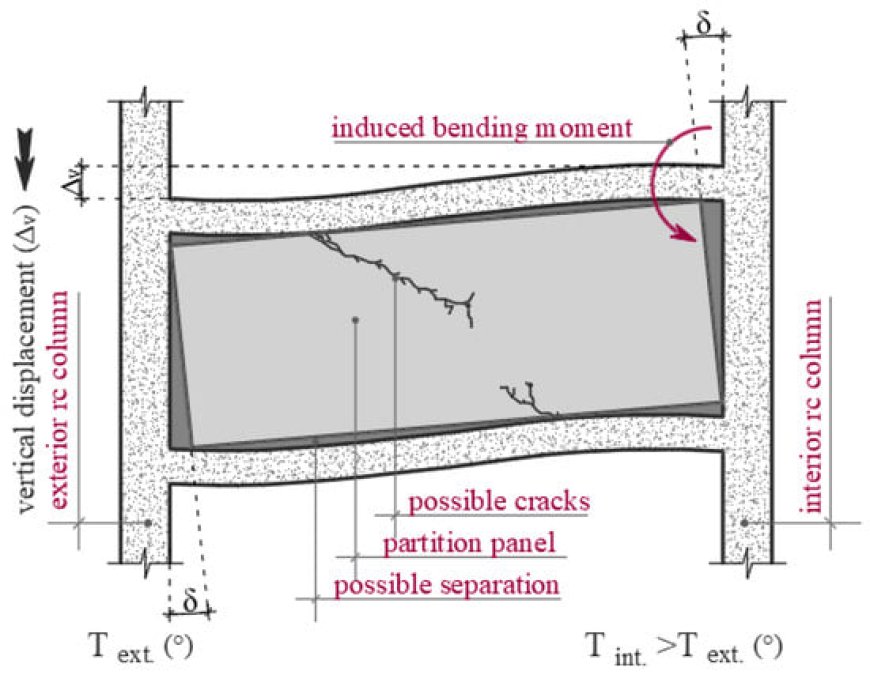
Vertical shortening, a phenomenon inherent to concrete structures, plays a key role in the quality and safety of construction, particularly in tall reinforced concrete buildings. This behavior is intrinsically linked to the time-dependent properties of concrete, encompassing both creep and shrinkage. Neglecting these aspects, especially when non-uniformly distributed, can give rise to various structural issues, including partition distress, overloading, and potential cracking in horizontal elements. This paper delves into the principal factors influencing vertical shortening and presents a rigorous approach to their evaluation, treating creep and shrinkage as critical parameters. The investigation employs two illustrative case studies: the first revolves around a 15-story reinforced concrete building with single columns supporting tributary areas at various levels, acting as a calibration case; the second encompasses a 30-story reinforced concrete structure employing a dual system, providing a broader perspective applicable to three-dimensional structures. A diverse array of analyses is conducted, incorporating considerations for concrete’s linear and nonlinear behavior as well as the impact of construction stages. Our findings reveal that vertical shortening is directly proportional to the building’s height and inversely related to concrete strength, longitudinal reinforcement ratios, member dimensions, volume-to-surface ratios, age of the structure upon load application, and relative humidity. Consequently, precise assessments of differential shortening effects are paramount. The utilization of staged construction analysis and time-dependent effects is recommended as the most suitable approach for evaluating vertical shortening effects.
CivilEng, Vol. 5, Pages 191-208: Ensuring Structural Integrity: An Evaluation of Vertical Shortening in Tall Concrete Buildings
CivilEng doi: 10.3390/civileng5010010
Authors: Esmerald Filaj Enio Deneko Reza Moezzi Mohammad Gheibi Andres Annuk
Vertical shortening, a phenomenon inherent to concrete structures, plays a key role in the quality and safety of construction, particularly in tall reinforced concrete buildings. This behavior is intrinsically linked to the time-dependent properties of concrete, encompassing both creep and shrinkage. Neglecting these aspects, especially when non-uniformly distributed, can give rise to various structural issues, including partition distress, overloading, and potential cracking in horizontal elements. This paper delves into the principal factors influencing vertical shortening and presents a rigorous approach to their evaluation, treating creep and shrinkage as critical parameters. The investigation employs two illustrative case studies: the first revolves around a 15-story reinforced concrete building with single columns supporting tributary areas at various levels, acting as a calibration case; the second encompasses a 30-story reinforced concrete structure employing a dual system, providing a broader perspective applicable to three-dimensional structures. A diverse array of analyses is conducted, incorporating considerations for concrete’s linear and nonlinear behavior as well as the impact of construction stages. Our findings reveal that vertical shortening is directly proportional to the building’s height and inversely related to concrete strength, longitudinal reinforcement ratios, member dimensions, volume-to-surface ratios, age of the structure upon load application, and relative humidity. Consequently, precise assessments of differential shortening effects are paramount. The utilization of staged construction analysis and time-dependent effects is recommended as the most suitable approach for evaluating vertical shortening effects.
What's Your Reaction?