CivilEng, Vol. 4, Pages 966-981: Presentation of a Rainfall–Runoff Retention Model (3RM) Based on Antecedent Effective Retention for Estimating Runoff in Seven Basins in Iran
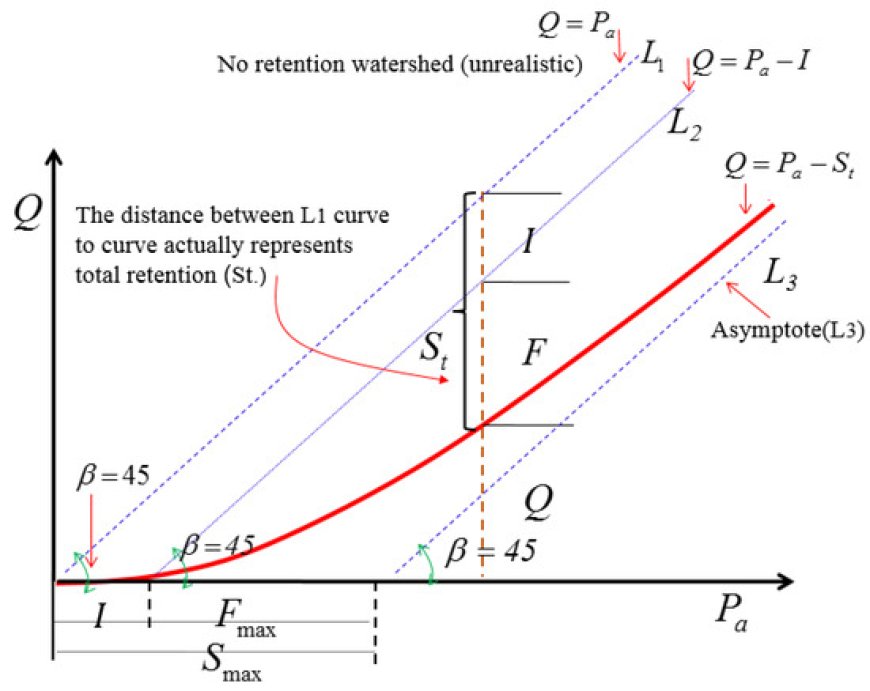
This study aims to correct and assess the SCS-CN model. In this research, the 3RM model (written by Shamohammadi) has been modified in such a way that the maximum primary retention (I), maximum secondary retention (Fmax), and basin potential retention (Smax) can be calculated using precipitation (Pa). The purpose of this study is to evaluate the total retention model (St=f(Fmax,Smax,pa)) and the runoff model (Q=f(St,pa)) using the mountain basins of Iran, including Emameh, Kasilian, Navrood, Darjazin, Kardeh, Khanmirza, and Mashin. The results showed that the primary retention, maximum secondary retention, and retention capacity are, respectively, 2.3, 30.4, and 32.7 mm in Imamah, 2.5, 48.6, and 51.1 mm in Kasilian, 2.4, 26.7, and 29.1 mm in Navrood, 3.2, 21.5, and 24.7 mm in Darjazin, 1.7, 15.0, and 16.7 mm in Kardeh, 2.5, 33.2, and 38.1 mm in Khanmirza, and 4.9, 44.5, and 50.6 mm in Mashine. Additionally, the λ (ratio of primary retention to potential retention) values for all basins are less than 0.2 (suggested by SCS) and vary between 0.05 in Kasilian and 0.1 in the Darjazin, Kardeh, and Mashine basins. The results of fitting the model to the rainfall-runoff data showed that the evaluation indices, including the coefficient of determination (R2), Nash–Sutcliffe (NS), and root mean square error (RMSE), for predicting the runoff in the basins varied between 0.78 to 0.96, 0.78 to 0.961, and 0.86 to 2.28, respectively. According to the obtained results, it can be concluded that the model has an acceptable ability to predict runoff for all the studied basins.
CivilEng, Vol. 4, Pages 966-981: Presentation of a Rainfall–Runoff Retention Model (3RM) Based on Antecedent Effective Retention for Estimating Runoff in Seven Basins in Iran
CivilEng doi: 10.3390/civileng4030052
Authors: Shayan Shamohammadi Ahmad Reza Ghasemi Kaveh Ostad-Ali-Askari Saeedeh Izadi
This study aims to correct and assess the SCS-CN model. In this research, the 3RM model (written by Shamohammadi) has been modified in such a way that the maximum primary retention (I), maximum secondary retention (Fmax), and basin potential retention (Smax) can be calculated using precipitation (Pa). The purpose of this study is to evaluate the total retention model (St=f(Fmax,Smax,pa)) and the runoff model (Q=f(St,pa)) using the mountain basins of Iran, including Emameh, Kasilian, Navrood, Darjazin, Kardeh, Khanmirza, and Mashin. The results showed that the primary retention, maximum secondary retention, and retention capacity are, respectively, 2.3, 30.4, and 32.7 mm in Imamah, 2.5, 48.6, and 51.1 mm in Kasilian, 2.4, 26.7, and 29.1 mm in Navrood, 3.2, 21.5, and 24.7 mm in Darjazin, 1.7, 15.0, and 16.7 mm in Kardeh, 2.5, 33.2, and 38.1 mm in Khanmirza, and 4.9, 44.5, and 50.6 mm in Mashine. Additionally, the λ (ratio of primary retention to potential retention) values for all basins are less than 0.2 (suggested by SCS) and vary between 0.05 in Kasilian and 0.1 in the Darjazin, Kardeh, and Mashine basins. The results of fitting the model to the rainfall-runoff data showed that the evaluation indices, including the coefficient of determination (R2), Nash–Sutcliffe (NS), and root mean square error (RMSE), for predicting the runoff in the basins varied between 0.78 to 0.96, 0.78 to 0.961, and 0.86 to 2.28, respectively. According to the obtained results, it can be concluded that the model has an acceptable ability to predict runoff for all the studied basins.
What's Your Reaction?