Bioengineering, Vol. 11, Pages 414: Human versus Rat PRF on Collagen Membranes: A Pilot Study of Mineralization in Rat Calvaria Defect Model
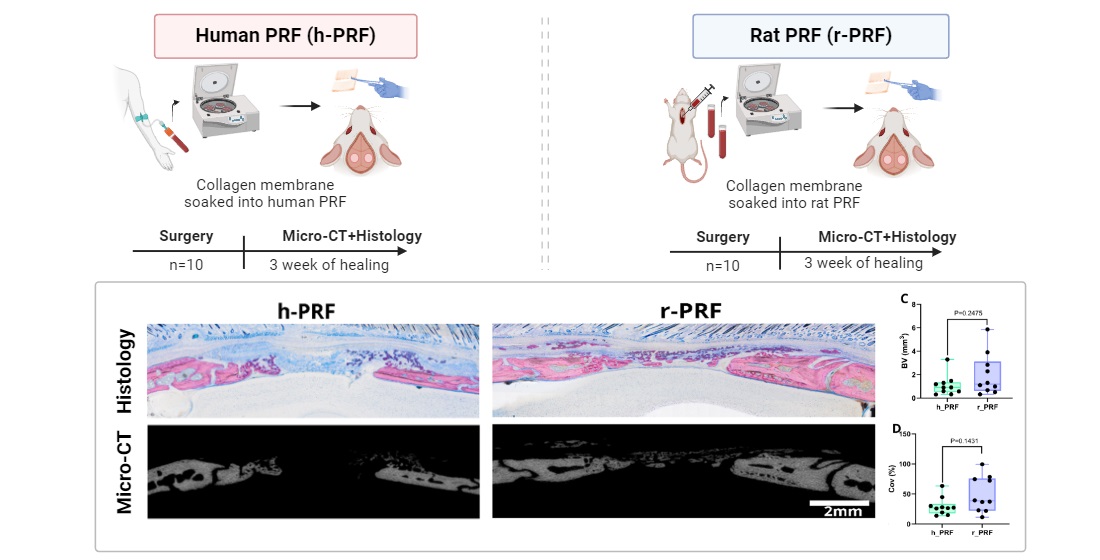
Platelet-rich fibrin, the coagulated plasma fraction of blood, is commonly used to support natural healing in clinical applications. The rat calvaria defect is a standardized model to study bone regeneration. It remains, however, unclear if the rat calvaria defect is appropriate to investigate the impact of human PRF (Platelet-Rich Fibrin) on bone regeneration. To this end, we soaked Bio-Gide® collagen membranes in human or rat liquid concentrated PRF before placing them onto 5 mm calvarial defects in Sprague Dawley rats. Three weeks later, histology and micro-computed tomography (μCT) were performed. We observed that the collagen membranes soaked with rat PRF show the characteristic features of new bone and areas of mineralized collagen matrix, indicated by a median mineralized volume of 1.5 mm3 (range: 0.9; 5.3 mm3). Histology revealed new bone growing underneath the membrane and hybrid bone where collagen fibers are embedded in the new bone. Moreover, areas of passive mineralization were observed. The collagen membranes soaked with human PRF, however, were devoid of histological features of new bone formation in the center of the defect; only occasionally, new bone formed at the defect margins. Human PRF (h-PRF) caused a median bone volume of 0.9 mm3 (range: 0.3–3.3 mm3), which was significantly lower than what was observed with rat PRF (r-PRF), with a BV median of 1.2 mm3 (range: 0.3–5.9 mm3). Our findings indicate that the rat calvaria defect model is suitable for assessing the effects of rat PRF on bone formation, but caution is warranted when extrapolating conclusions regarding the efficacy of human PRF.
Bioengineering, Vol. 11, Pages 414: Human versus Rat PRF on Collagen Membranes: A Pilot Study of Mineralization in Rat Calvaria Defect Model
Bioengineering doi: 10.3390/bioengineering11050414
Authors: Karol Ali Apaza Apaza Alccayhuaman Patrick Heimel Stefan Tangl Stefan Lettner Carina Kampleitner Layla Panahipour Ulrike Kuchler Reinhard Gruber
Platelet-rich fibrin, the coagulated plasma fraction of blood, is commonly used to support natural healing in clinical applications. The rat calvaria defect is a standardized model to study bone regeneration. It remains, however, unclear if the rat calvaria defect is appropriate to investigate the impact of human PRF (Platelet-Rich Fibrin) on bone regeneration. To this end, we soaked Bio-Gide® collagen membranes in human or rat liquid concentrated PRF before placing them onto 5 mm calvarial defects in Sprague Dawley rats. Three weeks later, histology and micro-computed tomography (μCT) were performed. We observed that the collagen membranes soaked with rat PRF show the characteristic features of new bone and areas of mineralized collagen matrix, indicated by a median mineralized volume of 1.5 mm3 (range: 0.9; 5.3 mm3). Histology revealed new bone growing underneath the membrane and hybrid bone where collagen fibers are embedded in the new bone. Moreover, areas of passive mineralization were observed. The collagen membranes soaked with human PRF, however, were devoid of histological features of new bone formation in the center of the defect; only occasionally, new bone formed at the defect margins. Human PRF (h-PRF) caused a median bone volume of 0.9 mm3 (range: 0.3–3.3 mm3), which was significantly lower than what was observed with rat PRF (r-PRF), with a BV median of 1.2 mm3 (range: 0.3–5.9 mm3). Our findings indicate that the rat calvaria defect model is suitable for assessing the effects of rat PRF on bone formation, but caution is warranted when extrapolating conclusions regarding the efficacy of human PRF.
What's Your Reaction?