Behavioral Sciences, Vol. 14, Pages 355: Visual Field Restriction in the Recognition of Basic Facial Expressions: A Combined Eye Tracking and Gaze Contingency Study
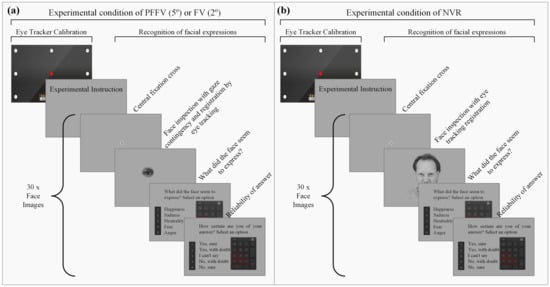
Uncertainties and discrepant results in identifying crucial areas for emotional facial expression recognition may stem from the eye tracking data analysis methods used. Many studies employ parameters of analysis that predominantly prioritize the examination of the foveal vision angle, ignoring the potential influences of simultaneous parafoveal and peripheral information. To explore the possible underlying causes of these discrepancies, we investigated the role of the visual field aperture in emotional facial expression recognition with 163 volunteers randomly assigned to three groups: no visual restriction (NVR), parafoveal and foveal vision (PFFV), and foveal vision (FV). Employing eye tracking and gaze contingency, we collected visual inspection and judgment data over 30 frontal face images, equally distributed among five emotions. Raw eye tracking data underwent Eye Movements Metrics and Visualizations (EyeMMV) processing. Accordingly, the visual inspection time, number of fixations, and fixation duration increased with the visual field restriction. Nevertheless, the accuracy showed significant differences among the NVR/FV and PFFV/FV groups, despite there being no difference in NVR/PFFV. The findings underscore the impact of specific visual field areas on facial expression recognition, highlighting the importance of parafoveal vision. The results suggest that eye tracking data analysis methods should incorporate projection angles extending to at least the parafoveal level.
Behavioral Sciences, Vol. 14, Pages 355: Visual Field Restriction in the Recognition of Basic Facial Expressions: A Combined Eye Tracking and Gaze Contingency Study
Behavioral Sciences doi: 10.3390/bs14050355
Authors: Melina Boratto Urtado Rafael Delalibera Rodrigues Sergio Sheiji Fukusima
Uncertainties and discrepant results in identifying crucial areas for emotional facial expression recognition may stem from the eye tracking data analysis methods used. Many studies employ parameters of analysis that predominantly prioritize the examination of the foveal vision angle, ignoring the potential influences of simultaneous parafoveal and peripheral information. To explore the possible underlying causes of these discrepancies, we investigated the role of the visual field aperture in emotional facial expression recognition with 163 volunteers randomly assigned to three groups: no visual restriction (NVR), parafoveal and foveal vision (PFFV), and foveal vision (FV). Employing eye tracking and gaze contingency, we collected visual inspection and judgment data over 30 frontal face images, equally distributed among five emotions. Raw eye tracking data underwent Eye Movements Metrics and Visualizations (EyeMMV) processing. Accordingly, the visual inspection time, number of fixations, and fixation duration increased with the visual field restriction. Nevertheless, the accuracy showed significant differences among the NVR/FV and PFFV/FV groups, despite there being no difference in NVR/PFFV. The findings underscore the impact of specific visual field areas on facial expression recognition, highlighting the importance of parafoveal vision. The results suggest that eye tracking data analysis methods should incorporate projection angles extending to at least the parafoveal level.
What's Your Reaction?