Hydrology, Vol. 11, Pages 20: Simulation and Application of Water Environment in Highly Urbanized Areas: A Case Study in Taihu Lake Basin
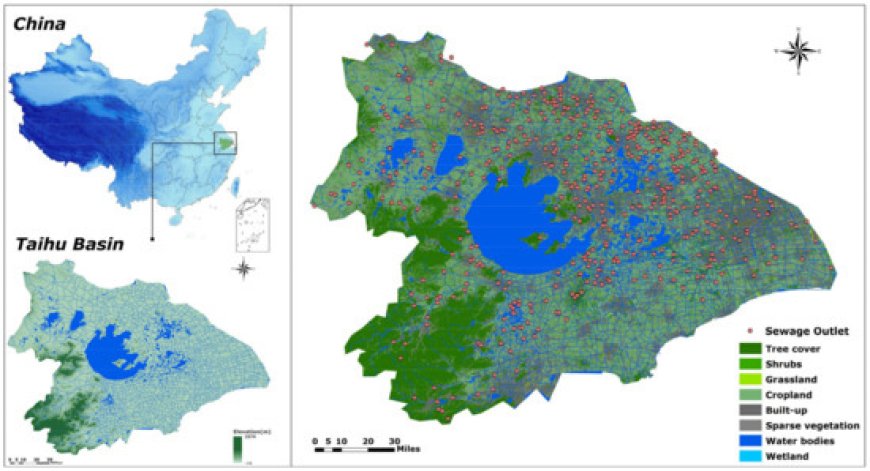
In the wake of frequent and intensive human activities, highly urbanized areas consistently grapple with severe water environmental challenges. It becomes imperative to establish corresponding water environment models for simulating and forecasting regional water quality, addressing the associated environmental risks. The distributed framework water environment modeling system (DF-WEMS) incorporates fundamental principles, including the distributed concept and node concentration mass conservation. It adeptly merges point source and non-point source pollution load models with zero-dimensional, one-dimensional, and two-dimensional water quality models. This integration is specifically tailored for various Hydrological Feature Units (HFUs), encompassing lakes, reservoirs, floodplains, paddy fields, plain rivers, and hydraulic engineering structures. This holistic model enables the simulation and prediction of the water environment conditions within the watershed. In the Taihu Lake basin of China, a highly urbanized region featuring numerous rivers, lakes and gates, the DF-WEMS is meticulously constructed, calibrated, and validated based on 26 key water quality monitoring stations. The results indicate a strong alignment between the simulation of water quality indicators (WQIs) and real-world conditions, demonstrating the model’s reliability. This model proves applicable to the simulation, prediction, planning, and management of the water environment within the highly urbanized watershed.
Hydrology, Vol. 11, Pages 20: Simulation and Application of Water Environment in Highly Urbanized Areas: A Case Study in Taihu Lake Basin
Hydrology doi: 10.3390/hydrology11020020
Authors: Pengxuan Zhao Chuanhai Wang Jinning Wu Gang Chen Tianshu Zhang Youlin Li Pingnan Zhang
In the wake of frequent and intensive human activities, highly urbanized areas consistently grapple with severe water environmental challenges. It becomes imperative to establish corresponding water environment models for simulating and forecasting regional water quality, addressing the associated environmental risks. The distributed framework water environment modeling system (DF-WEMS) incorporates fundamental principles, including the distributed concept and node concentration mass conservation. It adeptly merges point source and non-point source pollution load models with zero-dimensional, one-dimensional, and two-dimensional water quality models. This integration is specifically tailored for various Hydrological Feature Units (HFUs), encompassing lakes, reservoirs, floodplains, paddy fields, plain rivers, and hydraulic engineering structures. This holistic model enables the simulation and prediction of the water environment conditions within the watershed. In the Taihu Lake basin of China, a highly urbanized region featuring numerous rivers, lakes and gates, the DF-WEMS is meticulously constructed, calibrated, and validated based on 26 key water quality monitoring stations. The results indicate a strong alignment between the simulation of water quality indicators (WQIs) and real-world conditions, demonstrating the model’s reliability. This model proves applicable to the simulation, prediction, planning, and management of the water environment within the highly urbanized watershed.
What's Your Reaction?