
















AI, Vol. 5, Pages 446-464: Trust-Aware Reflective Control for Fault-Resilient Dynamic Task Response in Human–Swarm Cooperation
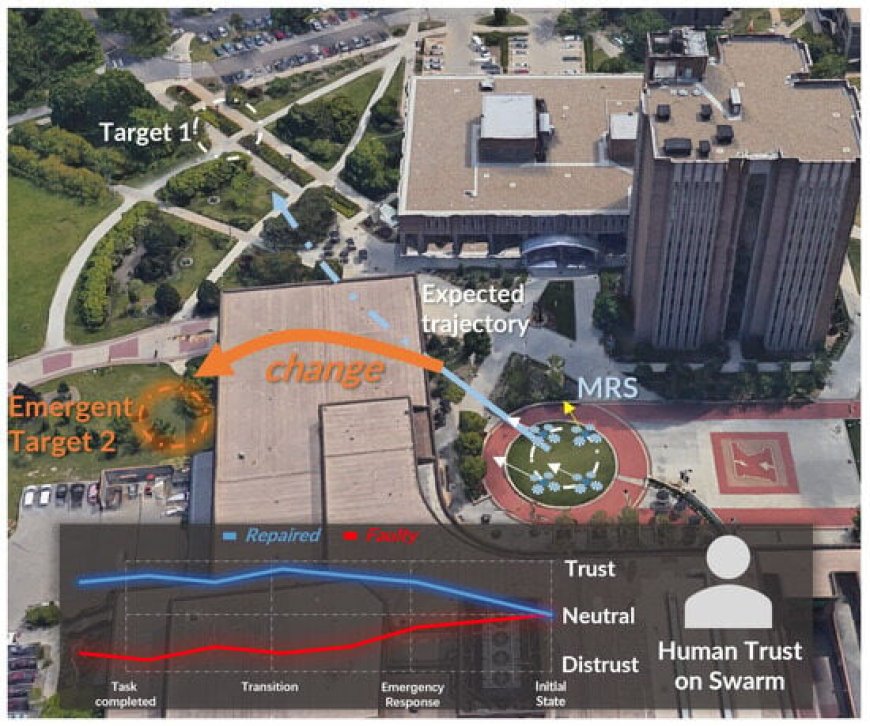
Due to the complexity of real-world deployments, a robot swarm is required to dynamically respond to tasks such as tracking multiple vehicles and continuously searching for victims. Frequent task assignments eliminate the need for system calibration time, but they also introduce uncertainty from previous tasks, which can undermine swarm performance. Therefore, responding to dynamic tasks presents a significant challenge for a robot swarm compared to handling tasks one at a time. In human–human cooperation, trust plays a crucial role in understanding each other’s performance expectations and adjusting one’s behavior for better cooperation. Taking inspiration from human trust, this paper introduces a trust-aware reflective control method called “Trust-R”. Trust-R, based on a weighted mean subsequence reduced algorithm (WMSR) and human trust modeling, enables a swarm to self-reflect on its performance from a human perspective. It proactively corrects faulty behaviors at an early stage before human intervention, mitigating the negative influence of uncertainty accumulated from dynamic tasks. Three typical task scenarios {Scenario 1: flocking to the assigned destination; Scenario 2: a transition between destinations; and Scenario 3: emergent response} were designed in the real-gravity simulation environment, and a human user study with 145 volunteers was conducted. Trust-R significantly improves both swarm performance and trust in dynamic task scenarios, marking a pivotal step forward in integrating trust dynamics into swarm robotics.
AI, Vol. 5, Pages 446-464: Trust-Aware Reflective Control for Fault-Resilient Dynamic Task Response in Human–Swarm Cooperation
Authors: Yibei Guo Yijiang Pang Joseph Lyons Michael Lewis Katia Sycara Rui Liu
Due to the complexity of real-world deployments, a robot swarm is required to dynamically respond to tasks such as tracking multiple vehicles and continuously searching for victims. Frequent task assignments eliminate the need for system calibration time, but they also introduce uncertainty from previous tasks, which can undermine swarm performance. Therefore, responding to dynamic tasks presents a significant challenge for a robot swarm compared to handling tasks one at a time. In human–human cooperation, trust plays a crucial role in understanding each other’s performance expectations and adjusting one’s behavior for better cooperation. Taking inspiration from human trust, this paper introduces a trust-aware reflective control method called “Trust-R”. Trust-R, based on a weighted mean subsequence reduced algorithm (WMSR) and human trust modeling, enables a swarm to self-reflect on its performance from a human perspective. It proactively corrects faulty behaviors at an early stage before human intervention, mitigating the negative influence of uncertainty accumulated from dynamic tasks. Three typical task scenarios {Scenario 1: flocking to the assigned destination; Scenario 2: a transition between destinations; and Scenario 3: emergent response} were designed in the real-gravity simulation environment, and a human user study with 145 volunteers was conducted. Trust-R significantly improves both swarm performance and trust in dynamic task scenarios, marking a pivotal step forward in integrating trust dynamics into swarm robotics.
What's Your Reaction?