AI, Vol. 5, Pages 115-135: A Flower Pollination Algorithm-Optimized Wavelet Transform and Deep CNN for Analyzing Binaural Beats and Anxiety
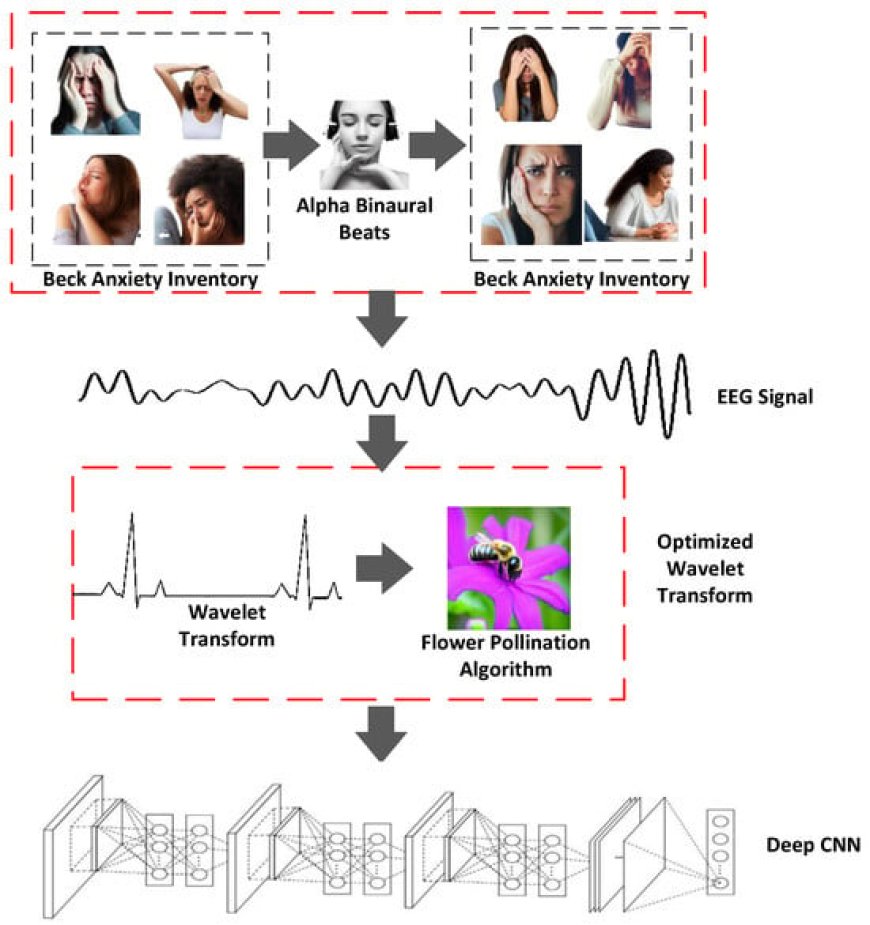
Binaural beats are a low-frequency form of acoustic stimulation that may be heard between 200 and 900 Hz and can help reduce anxiety as well as alter other psychological situations and states by affecting mood and cognitive function. However, prior research has only looked at the impact of binaural beats on state and trait anxiety using the STA-I scale; the level of anxiety has not yet been evaluated, and for the removal of artifacts the improper selection of wavelet parameters reduced the original signal energy. Hence, in this research, the level of anxiety when hearing binaural beats has been analyzed using a novel optimized wavelet transform in which optimized wavelet parameters are extracted from the EEG signal using the flower pollination algorithm, whereby artifacts are removed effectively from the EEG signal. Thus, EEG signals have five types of brainwaves in the existing models, which have not been analyzed optimally for brainwaves other than delta waves nor has the level of anxiety yet been analyzed using binaural beats. To overcome this, deep convolutional neural network (CNN)-based signal processing has been proposed. In this, deep features are extracted from optimized EEG signal parameters, which are precisely selected and adjusted to their most efficient values using the flower pollination algorithm, ensuring minimal signal energy reduction and artifact removal to maintain the integrity of the original EEG signal during analysis. These features provide the accurate classification of various levels of anxiety, which provides more accurate results for the effects of binaural beats on anxiety from brainwaves. Finally, the proposed model is implemented in the Python platform, and the obtained results demonstrate its efficacy. The proposed optimized wavelet transform using deep CNN-based signal processing outperforms existing techniques such as KNN, SVM, LDA, and Narrow-ANN, with a high accuracy of 0.99%, precision of 0.99%, recall of 0.99%, F1-score of 0.99%, specificity of 0.999%, and error rate of 0.01%. Thus, the optimized wavelet transform with a deep CNN can perform an effective decomposition of EEG data and extract deep features related to anxiety to analyze the effect of binaural beats on anxiety levels.
AI, Vol. 5, Pages 115-135: A Flower Pollination Algorithm-Optimized Wavelet Transform and Deep CNN for Analyzing Binaural Beats and Anxiety
Authors: Devika Rankhambe Bharati Sanjay Ainapure Bhargav Appasani Amitkumar V. Jha
Binaural beats are a low-frequency form of acoustic stimulation that may be heard between 200 and 900 Hz and can help reduce anxiety as well as alter other psychological situations and states by affecting mood and cognitive function. However, prior research has only looked at the impact of binaural beats on state and trait anxiety using the STA-I scale; the level of anxiety has not yet been evaluated, and for the removal of artifacts the improper selection of wavelet parameters reduced the original signal energy. Hence, in this research, the level of anxiety when hearing binaural beats has been analyzed using a novel optimized wavelet transform in which optimized wavelet parameters are extracted from the EEG signal using the flower pollination algorithm, whereby artifacts are removed effectively from the EEG signal. Thus, EEG signals have five types of brainwaves in the existing models, which have not been analyzed optimally for brainwaves other than delta waves nor has the level of anxiety yet been analyzed using binaural beats. To overcome this, deep convolutional neural network (CNN)-based signal processing has been proposed. In this, deep features are extracted from optimized EEG signal parameters, which are precisely selected and adjusted to their most efficient values using the flower pollination algorithm, ensuring minimal signal energy reduction and artifact removal to maintain the integrity of the original EEG signal during analysis. These features provide the accurate classification of various levels of anxiety, which provides more accurate results for the effects of binaural beats on anxiety from brainwaves. Finally, the proposed model is implemented in the Python platform, and the obtained results demonstrate its efficacy. The proposed optimized wavelet transform using deep CNN-based signal processing outperforms existing techniques such as KNN, SVM, LDA, and Narrow-ANN, with a high accuracy of 0.99%, precision of 0.99%, recall of 0.99%, F1-score of 0.99%, specificity of 0.999%, and error rate of 0.01%. Thus, the optimized wavelet transform with a deep CNN can perform an effective decomposition of EEG data and extract deep features related to anxiety to analyze the effect of binaural beats on anxiety levels.
What's Your Reaction?