AI, Vol. 4, Pages 692-705: Comparison of Various Nitrogen and Water Dual Stress Effects for Predicting Relative Water Content and Nitrogen Content in Maize Plants through Hyperspectral Imaging
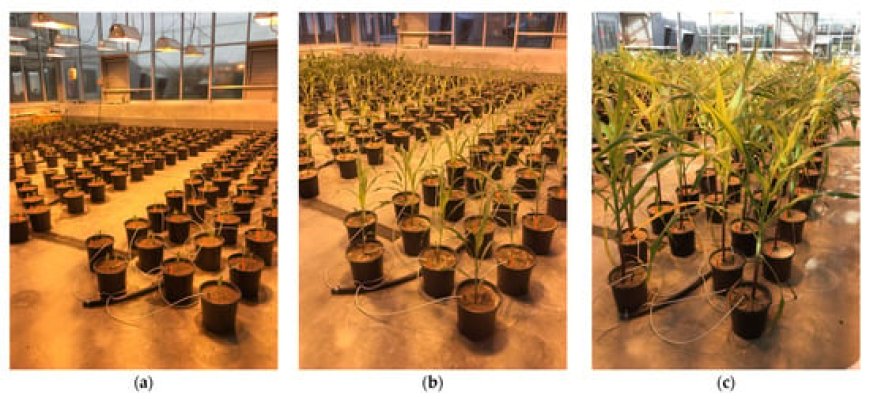
Water and nitrogen (N) are major factors in plant growth and agricultural production. However, these are often confounded and produce overlapping symptoms of plant stress. The objective of this study is to verify whether the different levels of N treatment influence water status prediction and vice versa with hyperspectral modeling. We cultivated 108 maize plants in a greenhouse under three-level N treatments in combination with three-level water treatments. Hyperspectral images were collected from those plants, then Relative Water Content (RWC), as well as N content, was measured as ground truth. A Partial Least Squares (PLS) regression analysis was used to build prediction models for RWC and N content. Then, their accuracy and robustness were compared according to the different N treatment datasets and different water treatment datasets, respectively. The results demonstrated that the PLS prediction for RWC using hyperspectral data was impacted by N stress difference (Ratio of Performance to Deviation; RPD from 0.87 to 2.27). Furthermore, the dataset with water and N dual stresses improved model accuracy and robustness (RPD from 1.69 to 2.64). Conversely, the PLS prediction for N content was found to be robust against water stress difference (RPD from 2.33 to 3.06). In conclusion, we suggest that water and N dual treatments can be helpful in building models with wide applicability and high accuracy for evaluating plant water status such as RWC.
AI, Vol. 4, Pages 692-705: Comparison of Various Nitrogen and Water Dual Stress Effects for Predicting Relative Water Content and Nitrogen Content in Maize Plants through Hyperspectral Imaging
Authors: Hideki Maki Valerie Lynch Dongdong Ma Mitchell R. Tuinstra Masanori Yamasaki Jian Jin
Water and nitrogen (N) are major factors in plant growth and agricultural production. However, these are often confounded and produce overlapping symptoms of plant stress. The objective of this study is to verify whether the different levels of N treatment influence water status prediction and vice versa with hyperspectral modeling. We cultivated 108 maize plants in a greenhouse under three-level N treatments in combination with three-level water treatments. Hyperspectral images were collected from those plants, then Relative Water Content (RWC), as well as N content, was measured as ground truth. A Partial Least Squares (PLS) regression analysis was used to build prediction models for RWC and N content. Then, their accuracy and robustness were compared according to the different N treatment datasets and different water treatment datasets, respectively. The results demonstrated that the PLS prediction for RWC using hyperspectral data was impacted by N stress difference (Ratio of Performance to Deviation; RPD from 0.87 to 2.27). Furthermore, the dataset with water and N dual stresses improved model accuracy and robustness (RPD from 1.69 to 2.64). Conversely, the PLS prediction for N content was found to be robust against water stress difference (RPD from 2.33 to 3.06). In conclusion, we suggest that water and N dual treatments can be helpful in building models with wide applicability and high accuracy for evaluating plant water status such as RWC.
What's Your Reaction?