AI, Vol. 3, Pages 948-960: Detecting Emotions behind the Screen
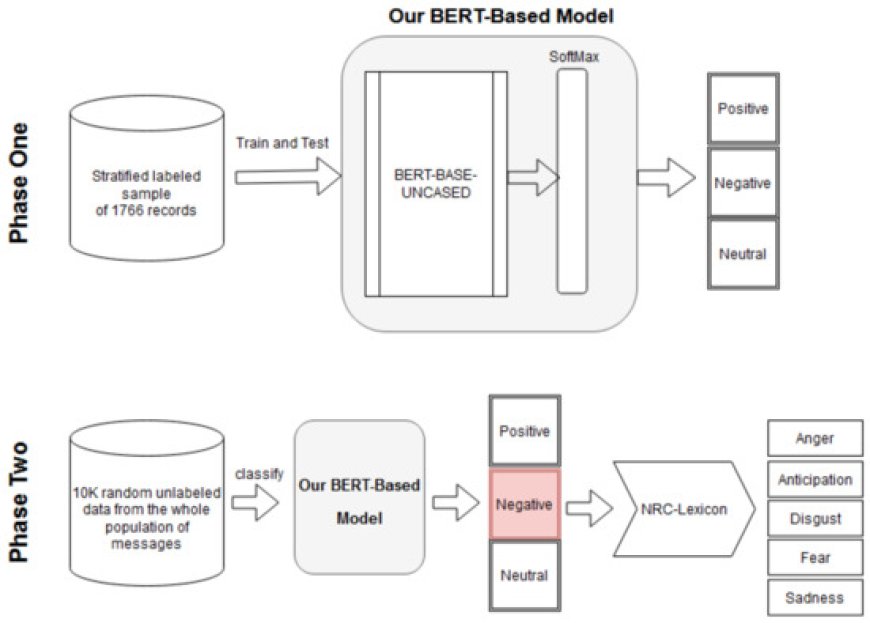
Students’ emotional health is a major contributor to educational success. Hence, to support students’ success in online learning platforms, we contribute with the development of an analysis of the emotional orientations and triggers in their text messages. Such analysis could be automated and used for early detection of the emotional status of students. In our approach, we relied on transfer learning to train the model, using the pre-trained Bidirectional Encoder Representations from Transformers model (BERT). The model classified messages as positive, negative, or neutral. The transfer learning model was then used to classify a larger unlabeled dataset and fine-grained emotions in the negative messages only, using NRC lexicon. In our analysis to the results, we focused in discovering the dominant negative emotions expressed and the most common words students used to express them. We believe this can be an important clue or first line of detection that may assist mental health practitioners to develop targeted programs for students, especially with the massive shift to online education due to the COVID-19 pandemic. We compared our model to a state-of-the-art ML-based model and found our model outperformed the other by achieving a 91% accuracy compared to an 86%. To the best of our knowledge, this is the first study to focus on a mental health analysis of students in online educational platforms other than massive open online courses (MOOCs).
AI, Vol. 3, Pages 948-960: Detecting Emotions behind the Screen
Authors: Najla Alkaabi Nazar Zaki Heba Ismail Manzoor Khan
Students’ emotional health is a major contributor to educational success. Hence, to support students’ success in online learning platforms, we contribute with the development of an analysis of the emotional orientations and triggers in their text messages. Such analysis could be automated and used for early detection of the emotional status of students. In our approach, we relied on transfer learning to train the model, using the pre-trained Bidirectional Encoder Representations from Transformers model (BERT). The model classified messages as positive, negative, or neutral. The transfer learning model was then used to classify a larger unlabeled dataset and fine-grained emotions in the negative messages only, using NRC lexicon. In our analysis to the results, we focused in discovering the dominant negative emotions expressed and the most common words students used to express them. We believe this can be an important clue or first line of detection that may assist mental health practitioners to develop targeted programs for students, especially with the massive shift to online education due to the COVID-19 pandemic. We compared our model to a state-of-the-art ML-based model and found our model outperformed the other by achieving a 91% accuracy compared to an 86%. To the best of our knowledge, this is the first study to focus on a mental health analysis of students in online educational platforms other than massive open online courses (MOOCs).
What's Your Reaction?