Water, Vol. 16, Pages 1234: Study on Properties of Micro-Nano Magnetic Composite Prepared by Mechanochemical Method of NdFeB Secondary Waste and Removal of As (V) from Mine Water
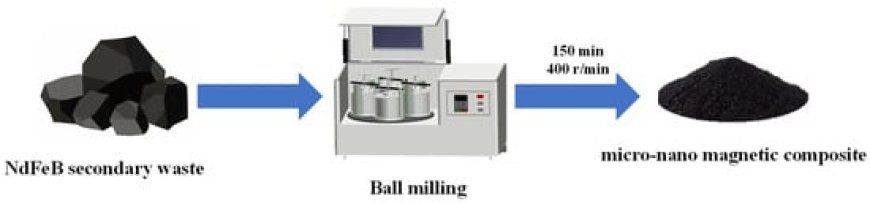
The secondary waste produced by NdFeB waste after rare earth recycling, with an annual output of more than tens of thousands of tons, is the largest solid waste emission source in the rare earth industry, and long-term storage causes land resource occupation and environmental pollution. Arsenic-containing mine wastewater has serious harm, wide distribution, and long duration of pollution. In this study, the mechanical ball milling method was used to activate NdFeB secondary waste to prepare micro-nano magnetic composite materials, the main components of which are Fe2O3, Fe3O4, and C. Under mechanical mechanochemical action, the particles are more dispersed, the particle size decreases, the specific surface area increases significantly, the crystal structure changes to amorphous structure, the degree of amorphous shape increases, and the content of Fe-OH increases. Applied to the treatment of As (V) in simulated mine water, it was found that the removal of As (V) by this material was mainly based on chemisorption and monolayer adsorption, and the maximum adsorption amount reached 10.477 mg/g. Zeta, FT-IT, and XPS characterization confirmed that the removal of As (V) was a coordination exchange reaction between the material and As (V) to form an inner sphere complex. The removal rate of As (V) decreased from 94.33% to 73.56% when the initial concentration of solution was 10 mg/L, pH value was 3.0, and material dosage was 1 g/L after 5 times of regrowth. This study provides a new way for the application of NdFeB secondary waste, which has low cost, green environmental protection, and wide application prospects.
Water, Vol. 16, Pages 1234: Study on Properties of Micro-Nano Magnetic Composite Prepared by Mechanochemical Method of NdFeB Secondary Waste and Removal of As (V) from Mine Water
Water doi: 10.3390/w16091234
Authors: Xiujuan Feng Yicheng Rao
The secondary waste produced by NdFeB waste after rare earth recycling, with an annual output of more than tens of thousands of tons, is the largest solid waste emission source in the rare earth industry, and long-term storage causes land resource occupation and environmental pollution. Arsenic-containing mine wastewater has serious harm, wide distribution, and long duration of pollution. In this study, the mechanical ball milling method was used to activate NdFeB secondary waste to prepare micro-nano magnetic composite materials, the main components of which are Fe2O3, Fe3O4, and C. Under mechanical mechanochemical action, the particles are more dispersed, the particle size decreases, the specific surface area increases significantly, the crystal structure changes to amorphous structure, the degree of amorphous shape increases, and the content of Fe-OH increases. Applied to the treatment of As (V) in simulated mine water, it was found that the removal of As (V) by this material was mainly based on chemisorption and monolayer adsorption, and the maximum adsorption amount reached 10.477 mg/g. Zeta, FT-IT, and XPS characterization confirmed that the removal of As (V) was a coordination exchange reaction between the material and As (V) to form an inner sphere complex. The removal rate of As (V) decreased from 94.33% to 73.56% when the initial concentration of solution was 10 mg/L, pH value was 3.0, and material dosage was 1 g/L after 5 times of regrowth. This study provides a new way for the application of NdFeB secondary waste, which has low cost, green environmental protection, and wide application prospects.
What's Your Reaction?