Water, Vol. 16, Pages 1225: A Distributed Catchment—Scale Evaluation of the Potential of Soil and Water Conservation Interventions to Reduce Storm Flow and Soil Loss
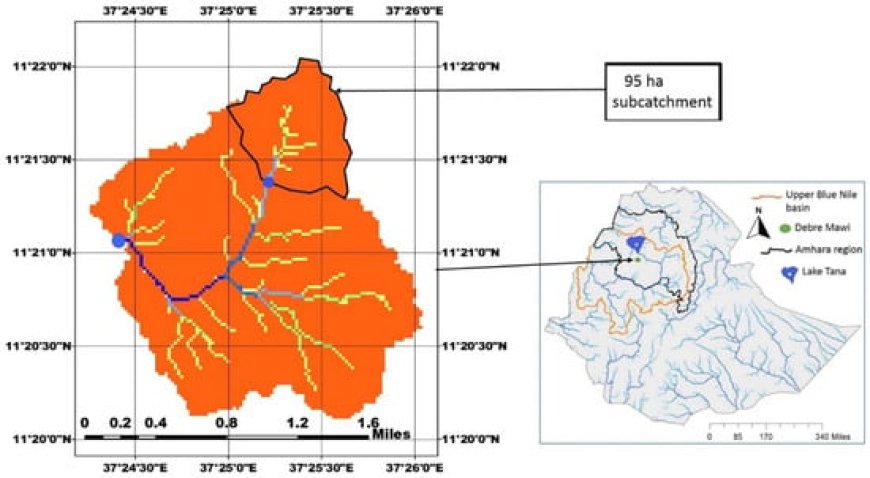
Finding effective ecosystem services (ESS) management practices to counteract land degradation and poverty is becoming increasingly urgent in the Ethiopian highlands, where livelihood security is strongly dependent on local ESS, particularly those provided by water and soil. In this paper, we test the effects of widely implemented soil and water conservation (SWC) interventions on storm flow and sediment concentration in the Debre Mawi watershed (representative of watersheds in the upper Blue Nile basin and Ethiopian highlands). The SWC interventions were tested with a Parameter Efficient Distributed (PED) model. The PED model simulates saturation excess runoff from degraded and saturated valley bottoms, and base and interflow from hillsides. The model was calibrated with observed runoff and sediment data in a 95-ha subcatchment. We found that the PED model simulated the discharge and soil loss well by decreasing the proportion of degraded lands due to installing SWC practices. The results show that four years after the implementation of SWC practices, the infiltration of rainwater was improved in 53% of the degraded lands. Thus, installing SWC practices on hillsides where infiltration is limited is most beneficial and will result in greater water availability during the dry phase, especially in locations where volcanic dikes block the lateral flow.
Water, Vol. 16, Pages 1225: A Distributed Catchment—Scale Evaluation of the Potential of Soil and Water Conservation Interventions to Reduce Storm Flow and Soil Loss
Water doi: 10.3390/w16091225
Authors: Tilashwork C. Alemie Wouter Buytaert Seifu A. Tilahun Tammo S. Steenhuis
Finding effective ecosystem services (ESS) management practices to counteract land degradation and poverty is becoming increasingly urgent in the Ethiopian highlands, where livelihood security is strongly dependent on local ESS, particularly those provided by water and soil. In this paper, we test the effects of widely implemented soil and water conservation (SWC) interventions on storm flow and sediment concentration in the Debre Mawi watershed (representative of watersheds in the upper Blue Nile basin and Ethiopian highlands). The SWC interventions were tested with a Parameter Efficient Distributed (PED) model. The PED model simulates saturation excess runoff from degraded and saturated valley bottoms, and base and interflow from hillsides. The model was calibrated with observed runoff and sediment data in a 95-ha subcatchment. We found that the PED model simulated the discharge and soil loss well by decreasing the proportion of degraded lands due to installing SWC practices. The results show that four years after the implementation of SWC practices, the infiltration of rainwater was improved in 53% of the degraded lands. Thus, installing SWC practices on hillsides where infiltration is limited is most beneficial and will result in greater water availability during the dry phase, especially in locations where volcanic dikes block the lateral flow.
What's Your Reaction?