Water, Vol. 16, Pages 1223: Combining Crop and Water Decisions to Manage Groundwater Overdraft over Decadal and Longer Timescales
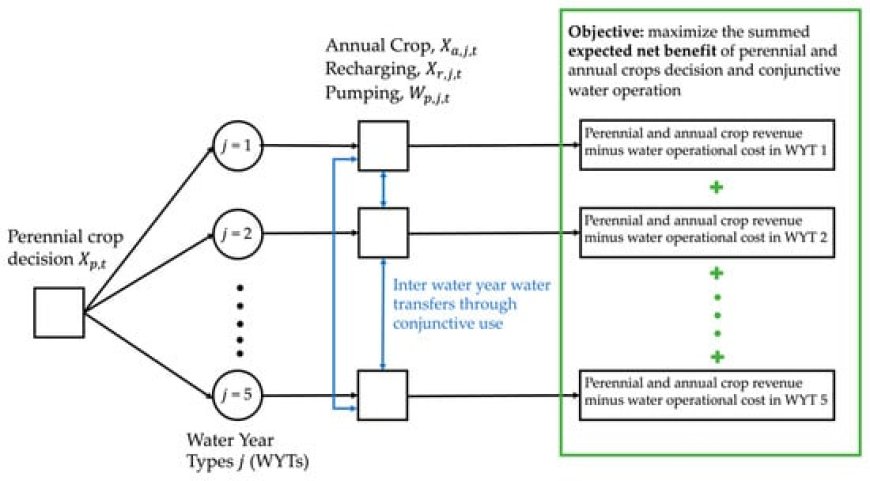
Coordinating management of groundwater, surface water, and irrigated crops is fundamental economically for many arid and semi-arid regions. This paper examines conjunctive water management for agriculture using hydro-economic optimization modeling. The analysis is integrated across two timescales: a two-stage stochastic decadal model for managing annual and perennial crops spanning dry and wet years and a far-horizon dynamic program embedding the decadal model into a longer groundwater policy setting. The modeling loosely represents California’s San Joaquin Valley and has insights for many irrigated arid and semi-arid regions relying on groundwater with variable annual hydrology. Results show how conjunctive water management can stabilize crop decisions and improve agricultural profitability across different water years by pumping more in dry years and increasing recharging groundwater in wetter years. Using groundwater as a buffer for droughts allows growing more higher-value perennial crops, which maximizes profit even with water-scarce conditions. Nevertheless, ending overdraft in basins with declining groundwater for profit-maximizing farming reduces annual crops to maintain more profitable perennial crops through droughts. Results are affected by economic discount rates and future climates. Operating and opportunity costs from forgone annual crops can reduce aquifer recharge early in regulatory periods.
Water, Vol. 16, Pages 1223: Combining Crop and Water Decisions to Manage Groundwater Overdraft over Decadal and Longer Timescales
Water doi: 10.3390/w16091223
Authors: Yiqing Yao Jay R. Lund Josué Medellín-Azuara
Coordinating management of groundwater, surface water, and irrigated crops is fundamental economically for many arid and semi-arid regions. This paper examines conjunctive water management for agriculture using hydro-economic optimization modeling. The analysis is integrated across two timescales: a two-stage stochastic decadal model for managing annual and perennial crops spanning dry and wet years and a far-horizon dynamic program embedding the decadal model into a longer groundwater policy setting. The modeling loosely represents California’s San Joaquin Valley and has insights for many irrigated arid and semi-arid regions relying on groundwater with variable annual hydrology. Results show how conjunctive water management can stabilize crop decisions and improve agricultural profitability across different water years by pumping more in dry years and increasing recharging groundwater in wetter years. Using groundwater as a buffer for droughts allows growing more higher-value perennial crops, which maximizes profit even with water-scarce conditions. Nevertheless, ending overdraft in basins with declining groundwater for profit-maximizing farming reduces annual crops to maintain more profitable perennial crops through droughts. Results are affected by economic discount rates and future climates. Operating and opportunity costs from forgone annual crops can reduce aquifer recharge early in regulatory periods.
What's Your Reaction?