Water, Vol. 16, Pages 1196: A Framework for Assessing Food Baskets Based on Water and Carbon Footprints
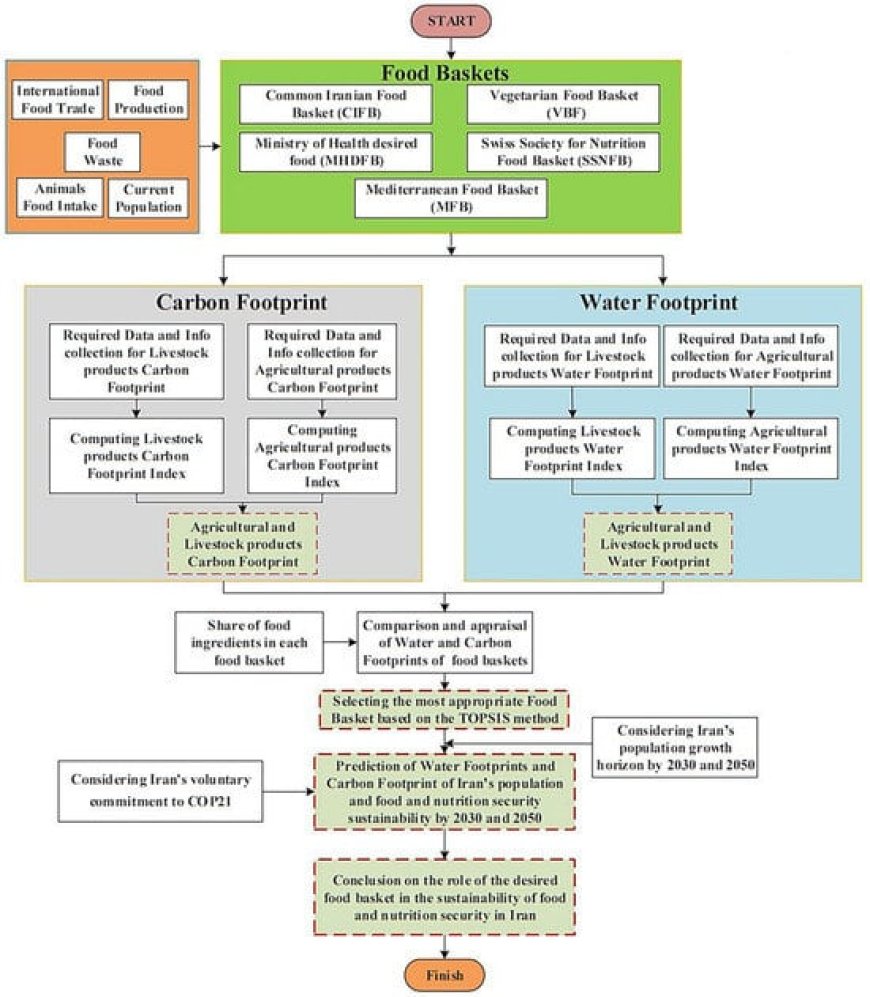
The composition of food baskets can significantly influence the water consumption rate and society’s environmental impact. This study evaluates the sustainability of Iran’s food and nutrition security by evaluating five food baskets using water and carbon-footprint indices. These food baskets are the common Iranian food basket (CIFB), the vegetarian food basket (VFB), the Ministry of Health desired food basket (MHDFB), the Swiss Society for Nutrition food basket (SSNFB), and the Mediterranean food basket (MFB). This study also examines the role of Iran’s agricultural sector under the Paris Climate Change Agreement (COP21). The TOPSIS multi-criteria decision-making method was used to identify the most desirable food basket. The results of this study show that the VFB could be the most desirable alternative to the CIFB. Replacing the CIFB with the VFB causes a 10% and 21% lower water and carbon footprint, respectively. From a 30-year perspective (around 2050), choosing the VFB would reduce the blue water footprint by 19.7 BCM and the gray water footprint by 3.6 BCM compared to the CIFB. According to the provisions of COP21 regarding Iran’s voluntary program to reduce greenhouse gas emissions, the agricultural sector will be one of the sources of greenhouse gas emissions that will face an upward trend. Hence, to adhere to this voluntary commitment, these emissions should be reduced by changing the CIFB to the VFB or reducing emissions in other sectors, such as industry. Choosing the VFB can reduce 10.7 million tons of CO2 emissions, which can be a significant step for the agricultural sector in Iran in reducing greenhouse gas emissions. Overall, considering the characteristics of farm products (water and carbon footprints) in Iran, a country located in a semi-arid climate, the VFB is recommended.
Water, Vol. 16, Pages 1196: A Framework for Assessing Food Baskets Based on Water and Carbon Footprints
Water doi: 10.3390/w16091196
Authors: Ali Mohammadi Saman Javadi Hossein Yousefi Hamed Pouraram Timothy O. Randhir
The composition of food baskets can significantly influence the water consumption rate and society’s environmental impact. This study evaluates the sustainability of Iran’s food and nutrition security by evaluating five food baskets using water and carbon-footprint indices. These food baskets are the common Iranian food basket (CIFB), the vegetarian food basket (VFB), the Ministry of Health desired food basket (MHDFB), the Swiss Society for Nutrition food basket (SSNFB), and the Mediterranean food basket (MFB). This study also examines the role of Iran’s agricultural sector under the Paris Climate Change Agreement (COP21). The TOPSIS multi-criteria decision-making method was used to identify the most desirable food basket. The results of this study show that the VFB could be the most desirable alternative to the CIFB. Replacing the CIFB with the VFB causes a 10% and 21% lower water and carbon footprint, respectively. From a 30-year perspective (around 2050), choosing the VFB would reduce the blue water footprint by 19.7 BCM and the gray water footprint by 3.6 BCM compared to the CIFB. According to the provisions of COP21 regarding Iran’s voluntary program to reduce greenhouse gas emissions, the agricultural sector will be one of the sources of greenhouse gas emissions that will face an upward trend. Hence, to adhere to this voluntary commitment, these emissions should be reduced by changing the CIFB to the VFB or reducing emissions in other sectors, such as industry. Choosing the VFB can reduce 10.7 million tons of CO2 emissions, which can be a significant step for the agricultural sector in Iran in reducing greenhouse gas emissions. Overall, considering the characteristics of farm products (water and carbon footprints) in Iran, a country located in a semi-arid climate, the VFB is recommended.
What's Your Reaction?