Water, Vol. 16, Pages 1178: Synthesis of Ce-La-Pr/Mn-O Ternary Oxide Composites via Co-Precipitation and Synergistic Photocatalytic Degradation of Cr(VI)
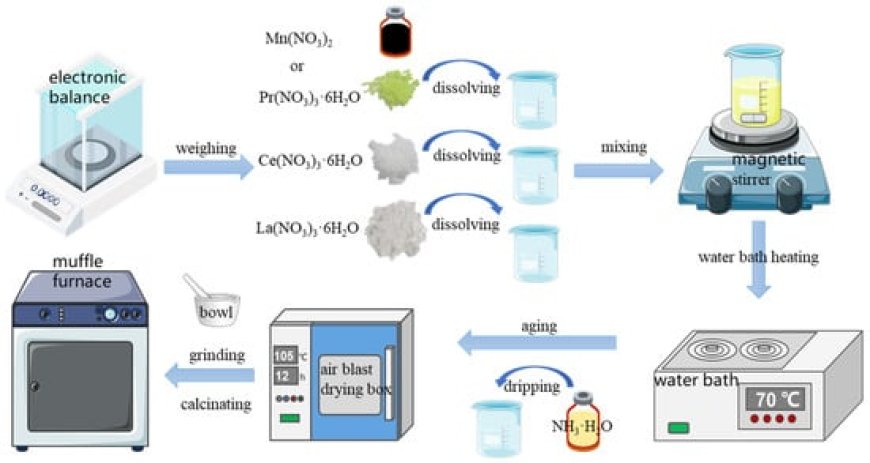
This study utilized a straightforward co-precipitation method to successfully synthesize Ce-La-X(Mn/Pr)-O composite materials for treating simulated hexavalent chromium (Cr(VI)) wastewater with distinctively porous and fluffy textures, along with tubular morphologies. Notably, Ce-La-Mn-O demonstrated a remarkable specific surface area of 96.2698 m2/g, mesoporous architecture with a pore diameter of 6.9511 nm, and an impressive adsorption capacity of 88.79 mg/g. Under optimized conditions, specifically an initial Cr(VI) concentration of 20 mg/L, a Ce-La-Mn-O dosage of 0.8 g/L, a reaction temperature of 40 °C, an initial pH of 6, and with the application of simulated daylight, the removal rate of Cr(VI) exceeded 98% within 15 min. Even after three cycles, the removal rate was maintained at above 80%. Based on a comprehensive suite of morphological, structural, and performance characterizations, the introduction of Mn/Pr was found to modify the structure of Ce-La-O and enhance the synergistic interactions among the metals within the Ce-La-O framework. In addition, Ce-La-Mn-O exhibited superior visible light absorption properties and dual functionality for catalytic reduction and adsorption. All three materials were found to form -OH polar bond functional groups, converting it to Cr(III) and subsequently forming Cr(OH)3. The Ce-La-X(Mn/Pr)-O composite materials provide a robust theoretical foundation for exploring the dual functional synergistic effects in the efficient removal of Cr(VI) from aqueous systems, indicating their vast potential for practical applications.
Water, Vol. 16, Pages 1178: Synthesis of Ce-La-Pr/Mn-O Ternary Oxide Composites via Co-Precipitation and Synergistic Photocatalytic Degradation of Cr(VI)
Water doi: 10.3390/w16081178
Authors: Xiujuan Feng Zebang Yu
This study utilized a straightforward co-precipitation method to successfully synthesize Ce-La-X(Mn/Pr)-O composite materials for treating simulated hexavalent chromium (Cr(VI)) wastewater with distinctively porous and fluffy textures, along with tubular morphologies. Notably, Ce-La-Mn-O demonstrated a remarkable specific surface area of 96.2698 m2/g, mesoporous architecture with a pore diameter of 6.9511 nm, and an impressive adsorption capacity of 88.79 mg/g. Under optimized conditions, specifically an initial Cr(VI) concentration of 20 mg/L, a Ce-La-Mn-O dosage of 0.8 g/L, a reaction temperature of 40 °C, an initial pH of 6, and with the application of simulated daylight, the removal rate of Cr(VI) exceeded 98% within 15 min. Even after three cycles, the removal rate was maintained at above 80%. Based on a comprehensive suite of morphological, structural, and performance characterizations, the introduction of Mn/Pr was found to modify the structure of Ce-La-O and enhance the synergistic interactions among the metals within the Ce-La-O framework. In addition, Ce-La-Mn-O exhibited superior visible light absorption properties and dual functionality for catalytic reduction and adsorption. All three materials were found to form -OH polar bond functional groups, converting it to Cr(III) and subsequently forming Cr(OH)3. The Ce-La-X(Mn/Pr)-O composite materials provide a robust theoretical foundation for exploring the dual functional synergistic effects in the efficient removal of Cr(VI) from aqueous systems, indicating their vast potential for practical applications.
What's Your Reaction?