Water, Vol. 16, Pages 1149: Aminated Spherical SiO2 Synthesized from Fly Ash and Its Application for Pb2+ and Cu2+ Sorption
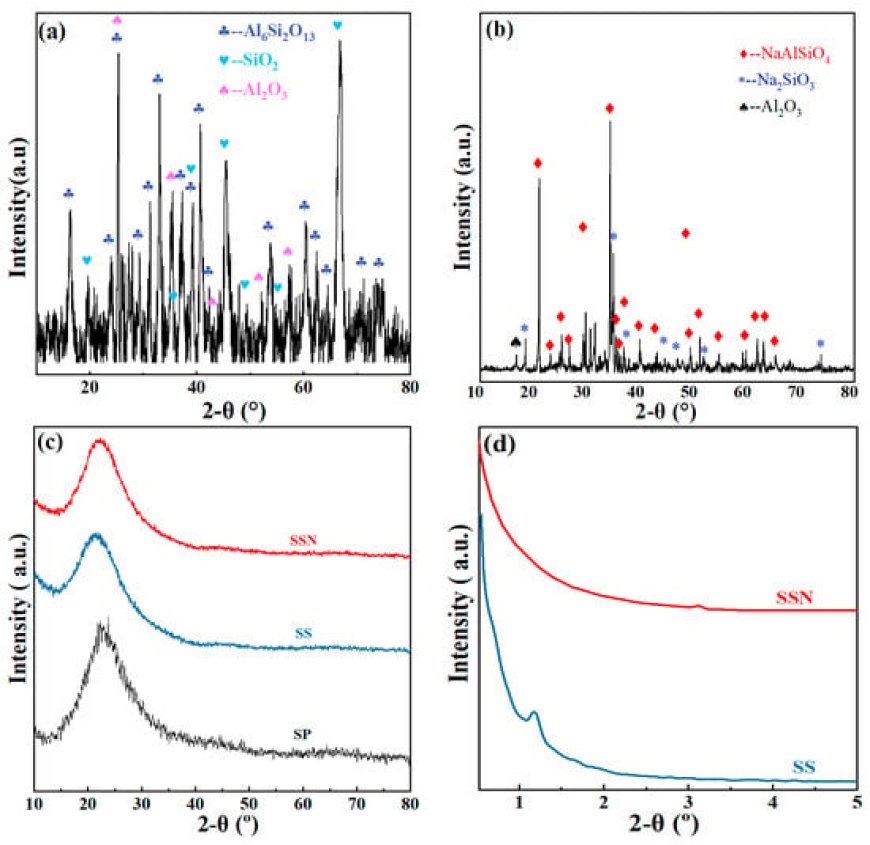
Fly ash was utilized as raw material for the preparation of spherical SiO2 (SS), which was subsequently ammonified using APTES (H2NCH2CH2CH2Si(OC2H5)3) to obtain aminated spherical SiO2 (SSN). The physicochemical properties of SS and SSN were systematically characterized. Notably, SS exhibited a remarkable specific surface area and pore volume, enabling it to accommodate abundant nitrogen-containing groups. These functional groups served as crucial active sorption sites, significantly enhancing the sorption capacity of SiO2 for Pb2+ and Cu2+ ions. Thus, the removal efficiency was above 99.9% when using dosages of 4 and 6 g/L SSN in solutions containing 200 mg/L of Pb2+ and Cu2+, respectively. Additionally, SSN showed a higher theoretical maximum sorption capacity for Pb2+ and Cu2+ ions, as determined by the Langmuir isotherm model, with values of 185.2 mg/g and 86.2 mg/g, respectively. These results surpass those reported in previous studies on adsorbents derived from fly ash. The chemical reactions that occurred between the aqueous cations and nitrogen-containing groups were identified as the pivotal factors governing the sorption of Pb2+ and Cu2+. This study presents a practical approach to fly ash utilization, along with the effective removal of Pb2+ and Cu2+ from water.
Water, Vol. 16, Pages 1149: Aminated Spherical SiO2 Synthesized from Fly Ash and Its Application for Pb2+ and Cu2+ Sorption
Water doi: 10.3390/w16081149
Authors: Jiahui Chen Nengsheng Liu Yunzhu Wang Xiang Li Zheren Zhang Le Liu Zhaoyang Dou Sufang He
Fly ash was utilized as raw material for the preparation of spherical SiO2 (SS), which was subsequently ammonified using APTES (H2NCH2CH2CH2Si(OC2H5)3) to obtain aminated spherical SiO2 (SSN). The physicochemical properties of SS and SSN were systematically characterized. Notably, SS exhibited a remarkable specific surface area and pore volume, enabling it to accommodate abundant nitrogen-containing groups. These functional groups served as crucial active sorption sites, significantly enhancing the sorption capacity of SiO2 for Pb2+ and Cu2+ ions. Thus, the removal efficiency was above 99.9% when using dosages of 4 and 6 g/L SSN in solutions containing 200 mg/L of Pb2+ and Cu2+, respectively. Additionally, SSN showed a higher theoretical maximum sorption capacity for Pb2+ and Cu2+ ions, as determined by the Langmuir isotherm model, with values of 185.2 mg/g and 86.2 mg/g, respectively. These results surpass those reported in previous studies on adsorbents derived from fly ash. The chemical reactions that occurred between the aqueous cations and nitrogen-containing groups were identified as the pivotal factors governing the sorption of Pb2+ and Cu2+. This study presents a practical approach to fly ash utilization, along with the effective removal of Pb2+ and Cu2+ from water.
What's Your Reaction?