Water, Vol. 16, Pages 1145: A Multi-Approach Analysis for Monitoring Wave Energy Driven by Coastal Extremes
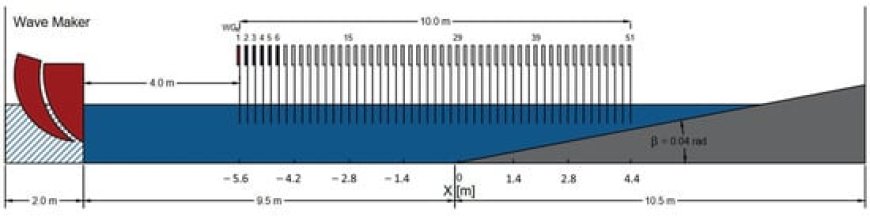
This research investigates the behavior and frequency evolution of extreme waves in coastal areas through a combination of physical modeling, spectral analysis, and artificial intelligence (AI) techniques. Laboratory experiments were conducted in a wave flume, deploying various wave spectra, including JONSWAP (γ = 7), JONSWAP (γ = 3.3), and Pierson–Moskowitz, using the dispersive focusing technique, covering a broad range of wave amplitudes. Wave characteristics were monitored using fifty-one gauges at distances between 4 m and 14 m from the wave generator, employing power spectral density (PSD) analysis to investigate wave energy subtleties. A spectral approach of discrete wavelets identified frequency components. The energy of the dominant frequency components, d5 and d4, representing the peak frequency (fp = 0.75 Hz) and its first harmonic (2fp = 1.5 Hz), respectively, exhibited a significant decrease in energy, while others increased, revealing potential correlations with zones of higher energy dissipation. This study underscores the repeatable and precise nature of results, demonstrating the Multilayer Perceptron (MLP) machine learning algorithm’s accuracy in predicting the energy of frequency components. The finding emphasizes the importance of a multi-approach analysis for effectively monitoring energy in extreme coastal waves.
Water, Vol. 16, Pages 1145: A Multi-Approach Analysis for Monitoring Wave Energy Driven by Coastal Extremes
Water doi: 10.3390/w16081145
Authors: Reine Matar Nizar Abcha Iskander Abroug Nicolas Lecoq Emma-Imen Turki
This research investigates the behavior and frequency evolution of extreme waves in coastal areas through a combination of physical modeling, spectral analysis, and artificial intelligence (AI) techniques. Laboratory experiments were conducted in a wave flume, deploying various wave spectra, including JONSWAP (γ = 7), JONSWAP (γ = 3.3), and Pierson–Moskowitz, using the dispersive focusing technique, covering a broad range of wave amplitudes. Wave characteristics were monitored using fifty-one gauges at distances between 4 m and 14 m from the wave generator, employing power spectral density (PSD) analysis to investigate wave energy subtleties. A spectral approach of discrete wavelets identified frequency components. The energy of the dominant frequency components, d5 and d4, representing the peak frequency (fp = 0.75 Hz) and its first harmonic (2fp = 1.5 Hz), respectively, exhibited a significant decrease in energy, while others increased, revealing potential correlations with zones of higher energy dissipation. This study underscores the repeatable and precise nature of results, demonstrating the Multilayer Perceptron (MLP) machine learning algorithm’s accuracy in predicting the energy of frequency components. The finding emphasizes the importance of a multi-approach analysis for effectively monitoring energy in extreme coastal waves.
What's Your Reaction?