Water, Vol. 16, Pages 1133: Advancing Digital Image-Based Recognition of Soil Water Content: A Case Study in Bailu Highland, Shaanxi Province, China
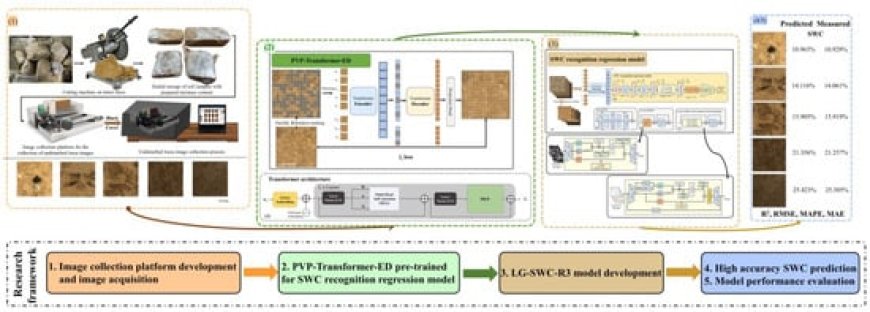
Soil water content (SWC) plays a vital role in agricultural management, geotechnical engineering, hydrological modeling, and climate research. Image-based SWC recognition methods show great potential compared to traditional methods. However, their accuracy and efficiency limitations hinder wide application due to their status as a nascent approach. To address this, we design the LG-SWC-R3 model based on an attention mechanism to leverage its powerful learning capabilities. To enhance efficiency, we propose a simple yet effective encoder–decoder architecture (PVP-Transformer-ED) designed on the principle of eliminating redundant spatial information from images. This architecture involves masking a high proportion of soil images and predicting the original image from the unmasked area to aid the PVP-Transformer-ED in understanding the spatial information correlation of the soil image. Subsequently, we fine-tune the SWC recognition model on the pre-trained encoder of the PVP-Transformer-ED. Extensive experimental results demonstrate the excellent performance of our designed model (R2 = 0.950, RMSE = 1.351%, MAPE = 0.081, MAE = 1.369%), surpassing traditional models. Although this method involves processing only a small fraction of original image pixels (approximately 25%), which may impact model performance, it significantly reduces training time while maintaining model error within an acceptable range. Our study provides valuable references and insights for the popularization and application of image-based SWC recognition methods.
Water, Vol. 16, Pages 1133: Advancing Digital Image-Based Recognition of Soil Water Content: A Case Study in Bailu Highland, Shaanxi Province, China
Water doi: 10.3390/w16081133
Authors: Yaozhong Zhang Han Zhang Hengxing Lan Yunchuang Li Honggang Liu Dexin Sun Erhao Wang Zhonghong Dong
Soil water content (SWC) plays a vital role in agricultural management, geotechnical engineering, hydrological modeling, and climate research. Image-based SWC recognition methods show great potential compared to traditional methods. However, their accuracy and efficiency limitations hinder wide application due to their status as a nascent approach. To address this, we design the LG-SWC-R3 model based on an attention mechanism to leverage its powerful learning capabilities. To enhance efficiency, we propose a simple yet effective encoder–decoder architecture (PVP-Transformer-ED) designed on the principle of eliminating redundant spatial information from images. This architecture involves masking a high proportion of soil images and predicting the original image from the unmasked area to aid the PVP-Transformer-ED in understanding the spatial information correlation of the soil image. Subsequently, we fine-tune the SWC recognition model on the pre-trained encoder of the PVP-Transformer-ED. Extensive experimental results demonstrate the excellent performance of our designed model (R2 = 0.950, RMSE = 1.351%, MAPE = 0.081, MAE = 1.369%), surpassing traditional models. Although this method involves processing only a small fraction of original image pixels (approximately 25%), which may impact model performance, it significantly reduces training time while maintaining model error within an acceptable range. Our study provides valuable references and insights for the popularization and application of image-based SWC recognition methods.
What's Your Reaction?