Nanomaterials, Vol. 14, Pages 739: Study on Spectrum Shifting and Pulse Splitting of Mode-Locked Fiber Lasers Based on NPR Technology
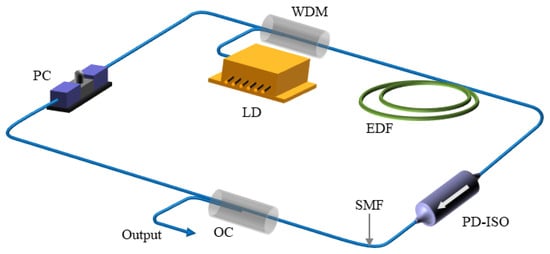
We conducted a systematic investigation into the spectral and pulse characteristics of C and L-band Nonlinear Polarization Rotation (NPR) mode-locked fiber lasers effectively employing nonlinear polarization rotation technology. In our experimental setup, we achieved a stable mode-locked state at 1560.076 nm, exhibiting a 3 dB spectral bandwidth of 9.1 nm. As the pump power increased, we observed spectral shifts accompanied by shifts in the first Kelly sideband and the generation of new Kelly sidebands. In this paper, the phenomenon of spectral deviation is elucidated through the interplay of self-phase modulation, group velocity drift, and polarization-dependent isolator (PD-ISO) filter effect, with an analysis of the formation and deviation of Kelly sidebands. Notably, spectral shift persisted even when the pump power exceeded 200 mW. However, continuous pump power escalation led to soliton splitting, resulting in the formation of new soliton beams. Based on the simultaneous generation of spectral shift and pulse splitting, our study contributes to an enhanced understanding of soliton dynamics in ultrafast fiber lasers and lays a foundation for the application of high-repetition-frequency harmonic mode-locked lasers with tunable wavelengths.
Nanomaterials, Vol. 14, Pages 739: Study on Spectrum Shifting and Pulse Splitting of Mode-Locked Fiber Lasers Based on NPR Technology
Nanomaterials doi: 10.3390/nano14090739
Authors: Zhenhua Hao Yu Hu Siyu Zhou Jinhui Liu Xiaohui Li Yishan Wang Cunxiao Gao
We conducted a systematic investigation into the spectral and pulse characteristics of C and L-band Nonlinear Polarization Rotation (NPR) mode-locked fiber lasers effectively employing nonlinear polarization rotation technology. In our experimental setup, we achieved a stable mode-locked state at 1560.076 nm, exhibiting a 3 dB spectral bandwidth of 9.1 nm. As the pump power increased, we observed spectral shifts accompanied by shifts in the first Kelly sideband and the generation of new Kelly sidebands. In this paper, the phenomenon of spectral deviation is elucidated through the interplay of self-phase modulation, group velocity drift, and polarization-dependent isolator (PD-ISO) filter effect, with an analysis of the formation and deviation of Kelly sidebands. Notably, spectral shift persisted even when the pump power exceeded 200 mW. However, continuous pump power escalation led to soliton splitting, resulting in the formation of new soliton beams. Based on the simultaneous generation of spectral shift and pulse splitting, our study contributes to an enhanced understanding of soliton dynamics in ultrafast fiber lasers and lays a foundation for the application of high-repetition-frequency harmonic mode-locked lasers with tunable wavelengths.
What's Your Reaction?