Hydrology, Vol. 11, Pages 49: Climatic Modeling of Seawater Intrusion in Coastal Aquifers: Understanding the Climate Change Impacts
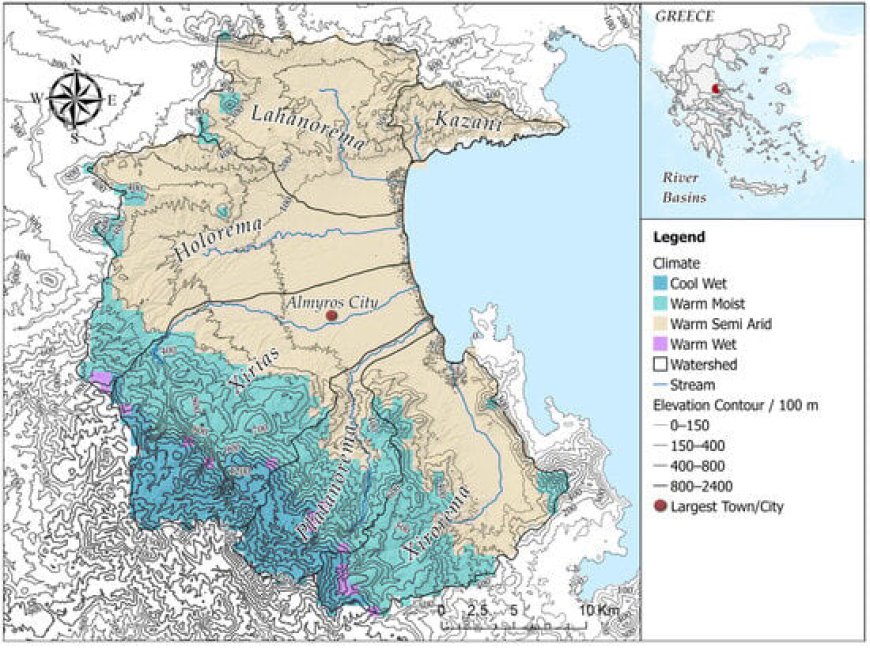
The study examines the impacts of climate change and sea level rise on coastal aquifers, focusing on the influence of the components of the water cycle on seawater intrusion, and the evolution of the phenomenon in the future. The simulation of coastal water resources was performed using an integrated modeling system (IMS), designed for agricultural coastal watersheds, which consists of inter-connected models of surface hydrology (UTHBAL), groundwater hydrology (MODFLOW), and seawater intrusion (SEAWAT). Climatic models for the adverse impact scenario (RCP8.5) and the medium impact scenario (RCP4.5) of climate change were used. Transient boundary head conditions were set to the coastal boundary, to dynamically represent the rise in sea level due to climate change. The response of groundwater in the coastal Almyros Basin, located in central Greece, was simulated from 1991 to 2100. The findings indicate that seawater intrusion will be advanced in the future, in both climate change scenarios. The models show varying patterns in groundwater recharge, with varying uncertainty projected into the future, and sensitivity to time in the fluctuation of the components of the water cycle.
Hydrology, Vol. 11, Pages 49: Climatic Modeling of Seawater Intrusion in Coastal Aquifers: Understanding the Climate Change Impacts
Hydrology doi: 10.3390/hydrology11040049
Authors: Aikaterini Lyra Athanasios Loukas Pantelis Sidiropoulos Nikitas Mylopoulos
The study examines the impacts of climate change and sea level rise on coastal aquifers, focusing on the influence of the components of the water cycle on seawater intrusion, and the evolution of the phenomenon in the future. The simulation of coastal water resources was performed using an integrated modeling system (IMS), designed for agricultural coastal watersheds, which consists of inter-connected models of surface hydrology (UTHBAL), groundwater hydrology (MODFLOW), and seawater intrusion (SEAWAT). Climatic models for the adverse impact scenario (RCP8.5) and the medium impact scenario (RCP4.5) of climate change were used. Transient boundary head conditions were set to the coastal boundary, to dynamically represent the rise in sea level due to climate change. The response of groundwater in the coastal Almyros Basin, located in central Greece, was simulated from 1991 to 2100. The findings indicate that seawater intrusion will be advanced in the future, in both climate change scenarios. The models show varying patterns in groundwater recharge, with varying uncertainty projected into the future, and sensitivity to time in the fluctuation of the components of the water cycle.
What's Your Reaction?