Hydrology, Vol. 10, Pages 211: Investigating Multilayer Aquifer Dynamics by Combining Geochemistry, Isotopes and Hydrogeological Context Analysis
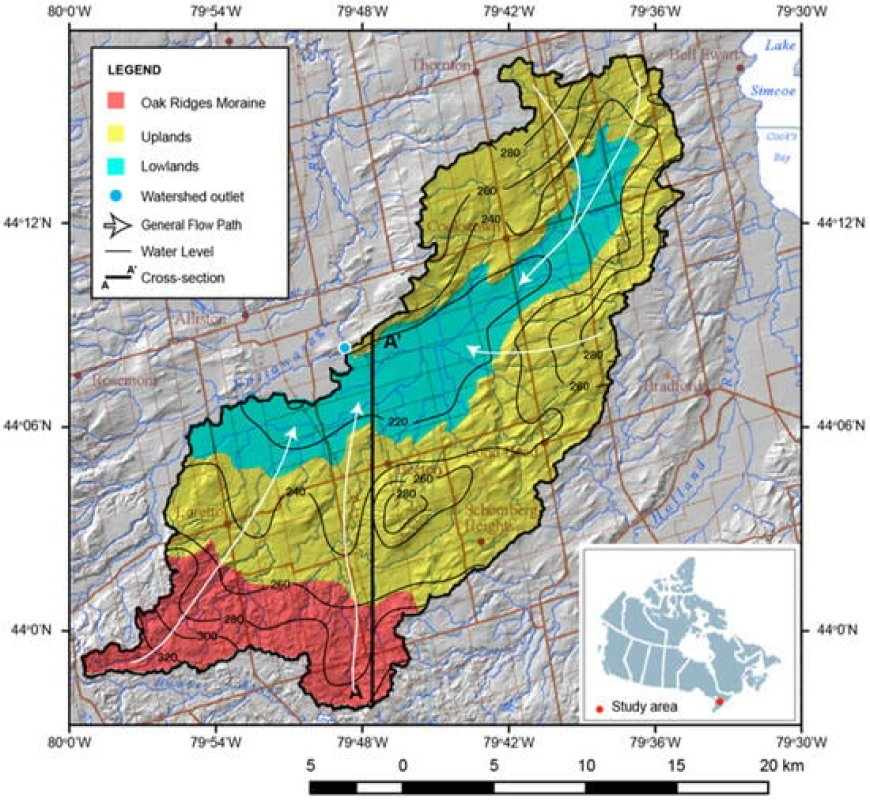
Geochemical tracers have the potential to provide valuable insights for constructing conceptual models of groundwater flow, especially in complex geological contexts. Nevertheless, the reliability of tracer interpretation hinges on its integration into a robust geological framework. In our research, we concentrated on delineating the groundwater flow dynamics in the Innisfil Creek watershed, located in Ontario, Canada. We amalgamated extensive hydrogeological data derived from a comprehensive 3D geological model with the analysis of 61 groundwater samples, encompassing major ions, stable water isotopes, tritium, and radiocarbon. By seamlessly incorporating regional physiographic characteristics, flow pathways, and confinement attributes, we bolstered the efficiency of these tracers, resulting in several notable findings. Firstly, we identified prominent recharge and discharge zones within the watershed. Secondly, we observed the coexistence of relatively shallow and fast-flowing paths with deeper, slower-flowing channels, responsible for transporting groundwater from ancient glacial events. Thirdly, we determined that cation exchange stands as the predominant mechanism governing the geochemical evolution of contemporary water as it migrates toward confined aquifers situated at the base of the Quaternary sequence. Fourthly, we provided evidence of the mixing of modern, low-mineralized water originating from unconfined aquifer units with deep, highly mineralized water within soil–bedrock interface aquifers. These findings not only contribute significantly to the development a conceptual flow model for the sustainable management of groundwater in the Innisfil watershed, but also offer practical insights that hold relevance for analogous geological complexities encountered in other regions.
Hydrology, Vol. 10, Pages 211: Investigating Multilayer Aquifer Dynamics by Combining Geochemistry, Isotopes and Hydrogeological Context Analysis
Hydrology doi: 10.3390/hydrology10110211
Authors: Francis Proteau-Bedard Paul Baudron Nicolas Benoit Miroslav Nastev Ryan Post Janie Masse-Dufresne
Geochemical tracers have the potential to provide valuable insights for constructing conceptual models of groundwater flow, especially in complex geological contexts. Nevertheless, the reliability of tracer interpretation hinges on its integration into a robust geological framework. In our research, we concentrated on delineating the groundwater flow dynamics in the Innisfil Creek watershed, located in Ontario, Canada. We amalgamated extensive hydrogeological data derived from a comprehensive 3D geological model with the analysis of 61 groundwater samples, encompassing major ions, stable water isotopes, tritium, and radiocarbon. By seamlessly incorporating regional physiographic characteristics, flow pathways, and confinement attributes, we bolstered the efficiency of these tracers, resulting in several notable findings. Firstly, we identified prominent recharge and discharge zones within the watershed. Secondly, we observed the coexistence of relatively shallow and fast-flowing paths with deeper, slower-flowing channels, responsible for transporting groundwater from ancient glacial events. Thirdly, we determined that cation exchange stands as the predominant mechanism governing the geochemical evolution of contemporary water as it migrates toward confined aquifers situated at the base of the Quaternary sequence. Fourthly, we provided evidence of the mixing of modern, low-mineralized water originating from unconfined aquifer units with deep, highly mineralized water within soil–bedrock interface aquifers. These findings not only contribute significantly to the development a conceptual flow model for the sustainable management of groundwater in the Innisfil watershed, but also offer practical insights that hold relevance for analogous geological complexities encountered in other regions.
What's Your Reaction?