Environments, Vol. 11, Pages 64: Biosurfactant-Assisted Phytoremediation of Diesel-Contaminated Soil by Three Different Legume Species
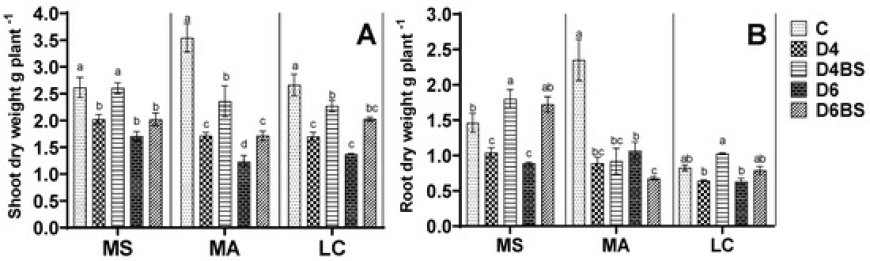
This study aims to assess the impact of HydroBreak PLUS biosurfactant on the phytoremediation of diesel-contaminated soil by three legume plant species: Medicago sativa, Lotus corniculatus, and Melilotus albus. Legumes were grown in soil contaminated with diesel (4.0 g kg−1, 6.0 g kg−1) for 90 days, and the changes in soil diesel and nutrient concentrations, plant growth, and physiological parameters were measured. Diesel negatively affected the biomass production of all legumes, though the reduction in growth rate was observed only in L. corniculatus and M. albus. L. corniculatus had the highest diesel removal rate of 93%, M. albus had the lowest of 87.9%, and unplanted treatments had significantly lower diesel removal rates (up to 66.5%). The biosurfactant mitigated diesel-induced reduction in plant shoot and root weight and an increase in L. corniculatus root biomass (24.2%) were observed at 4.0 g kg−1 diesel treatment. The use of biosurfactant accelerated diesel removal from the soil, though the effect was diesel soil concentration and plant species-dependent. In unplanted treatments, the diesel removal rates increased by 16.4% and 6.9% in the treatments with 4 and 6 mg kg−1, respectively. The effect of biosurfactants on diesel removal by plants was less pronounced and reached 4.6% and 3.2% in the treatments with 4 and 6 mg kg−1, respectively. The study revealed that the phytoremediation efficiency could not be directly linked to plant physiological parameters as only M. sativa changes in plant growth corresponded well with photosystem II performance. Implementation of legumes and biosurfactants has a positive effect on soil quality by its enrichment with inorganic P and soluble phenols, while no enrichment in NO3− and NH4+ was observed.
Environments, Vol. 11, Pages 64: Biosurfactant-Assisted Phytoremediation of Diesel-Contaminated Soil by Three Different Legume Species
Environments doi: 10.3390/environments11040064
Authors: Rimas Meištininkas Irena Vaškevičienė Austra Dikšaitytė Nerijus Pedišius Jūratė Žaltauskaitė
This study aims to assess the impact of HydroBreak PLUS biosurfactant on the phytoremediation of diesel-contaminated soil by three legume plant species: Medicago sativa, Lotus corniculatus, and Melilotus albus. Legumes were grown in soil contaminated with diesel (4.0 g kg−1, 6.0 g kg−1) for 90 days, and the changes in soil diesel and nutrient concentrations, plant growth, and physiological parameters were measured. Diesel negatively affected the biomass production of all legumes, though the reduction in growth rate was observed only in L. corniculatus and M. albus. L. corniculatus had the highest diesel removal rate of 93%, M. albus had the lowest of 87.9%, and unplanted treatments had significantly lower diesel removal rates (up to 66.5%). The biosurfactant mitigated diesel-induced reduction in plant shoot and root weight and an increase in L. corniculatus root biomass (24.2%) were observed at 4.0 g kg−1 diesel treatment. The use of biosurfactant accelerated diesel removal from the soil, though the effect was diesel soil concentration and plant species-dependent. In unplanted treatments, the diesel removal rates increased by 16.4% and 6.9% in the treatments with 4 and 6 mg kg−1, respectively. The effect of biosurfactants on diesel removal by plants was less pronounced and reached 4.6% and 3.2% in the treatments with 4 and 6 mg kg−1, respectively. The study revealed that the phytoremediation efficiency could not be directly linked to plant physiological parameters as only M. sativa changes in plant growth corresponded well with photosystem II performance. Implementation of legumes and biosurfactants has a positive effect on soil quality by its enrichment with inorganic P and soluble phenols, while no enrichment in NO3− and NH4+ was observed.
What's Your Reaction?