Environments, Vol. 11, Pages 63: Impacts on Urban VOCs and PM2.5 during a Wildfire Episode
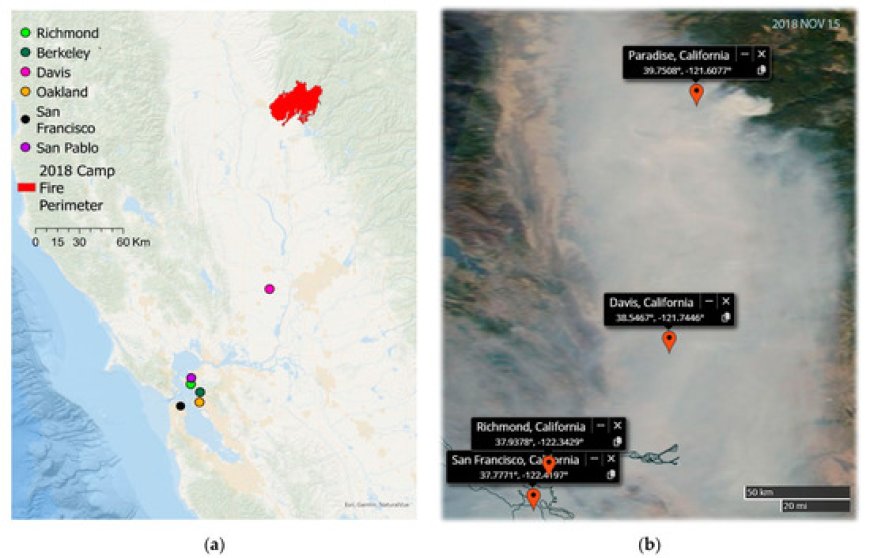
This study focuses on the impact of wildfire smoke emissions on regional, urban air quality during a wildfire event. We measured volatile organic compounds (VOCs) and fine particulate matter (PM2.5) in the San Francisco Bay Area to assess air quality during a wildfire event and compared them to those in a later non-wildfire period. VOCs were collected using thermal desorption tubes and quantified using thermal desorption-gas chromatography/mass spectrometry (TD-GC/MS). Elevated concentrations of VOCs such as 1,3,5-trimethylbenzene (0.33 ± 0.01 µg/m3), benzene (1.03 ± 0.02 µg/m3), toluene (2.15 ± 0.04 µg/m3), ethylbenzene (0.60 ± 0.02 µg/m3), and m, p-xylene (0.77 ± 0.07 µg/m3) were observed in the wildfire event. Compared with that in the non-wildfire season, the toluene concentration during the wildfire period was more than three times the non-wildfire concentration. Similarly, the benzene concentration during the wildfire was almost four times higher, and that of p, m-xylene was three times higher. The higher wildfire levels were statistically significant for sec-butylbenzene, 1,2,4-trimethylbenzene, n-propylbenzene, o-xylene, styrene, 1,3,5-trimethylbenzene, benzene, toluene, ethylbenzene, and p,m-xylene (p < 0.00001). These higher VOC levels compared with those for the non-fire period may potentially pose a public health concern. Open face passive sampler (OFPS)-collected PM was analyzed using scanning electron microscopy/energy dispersive X-ray spectroscopy (SEM/EDS) and revealed organic carbon tar balls. The highest daily average beta-attenuation-monitored PM2.5 during the fire period was 200 µg/m3 and the highest hourly average was 270 µg/m3. Monitoring gas phase species in addition to PM concentrations is useful during wildfire season to inform public health guidance.
Environments, Vol. 11, Pages 63: Impacts on Urban VOCs and PM2.5 during a Wildfire Episode
Environments doi: 10.3390/environments11040063
Authors: Zhong-Min Wang Ping Wang Jeff Wagner Kazukiyo Kumagai
This study focuses on the impact of wildfire smoke emissions on regional, urban air quality during a wildfire event. We measured volatile organic compounds (VOCs) and fine particulate matter (PM2.5) in the San Francisco Bay Area to assess air quality during a wildfire event and compared them to those in a later non-wildfire period. VOCs were collected using thermal desorption tubes and quantified using thermal desorption-gas chromatography/mass spectrometry (TD-GC/MS). Elevated concentrations of VOCs such as 1,3,5-trimethylbenzene (0.33 ± 0.01 µg/m3), benzene (1.03 ± 0.02 µg/m3), toluene (2.15 ± 0.04 µg/m3), ethylbenzene (0.60 ± 0.02 µg/m3), and m, p-xylene (0.77 ± 0.07 µg/m3) were observed in the wildfire event. Compared with that in the non-wildfire season, the toluene concentration during the wildfire period was more than three times the non-wildfire concentration. Similarly, the benzene concentration during the wildfire was almost four times higher, and that of p, m-xylene was three times higher. The higher wildfire levels were statistically significant for sec-butylbenzene, 1,2,4-trimethylbenzene, n-propylbenzene, o-xylene, styrene, 1,3,5-trimethylbenzene, benzene, toluene, ethylbenzene, and p,m-xylene (p < 0.00001). These higher VOC levels compared with those for the non-fire period may potentially pose a public health concern. Open face passive sampler (OFPS)-collected PM was analyzed using scanning electron microscopy/energy dispersive X-ray spectroscopy (SEM/EDS) and revealed organic carbon tar balls. The highest daily average beta-attenuation-monitored PM2.5 during the fire period was 200 µg/m3 and the highest hourly average was 270 µg/m3. Monitoring gas phase species in addition to PM concentrations is useful during wildfire season to inform public health guidance.
What's Your Reaction?