Environments, Vol. 11, Pages 6: Sustainability Assessment of Highly Fluorescent Carbon Dots Derived from Eucalyptus Leaves
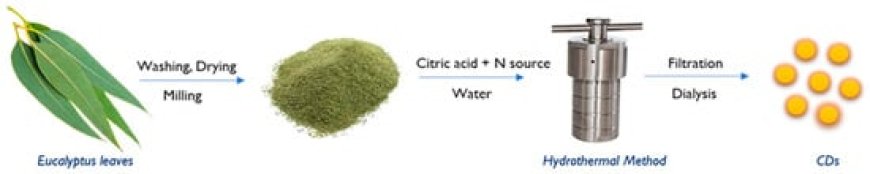
Biomass-derived carbon dots (CDs) are gaining much interest in recent times, as they provide a sustainable option with abundant availability, a low cost and tunable luminescence. Herein, we report a simple green synthesis method to produce highly fluorescent CDs from Eucalyptus globulus leaves using the one-pot hydrothermal approach. The fabricated CDs exhibit strong blue fluorescence with an excitation and emission maxima of 320 nm and 445 nm, respectively. The highest quantum yield (QY) obtained was 60.7%. With the reported optical properties and biocompatibility, CDs can be looked at as a promising candidate for potential biosensing applications. Moreover, we employed a life cycle assessment (LCA) cradle-to-gate approach to study the environmental impacts of the synthesis strategy used for the fabrication of CDs. The results point out that citric acid is the main hotspot in CD synthesis, regarding environmental impacts in most categories. This justifies the introduction of biomass, which reduces the amount of citric acid, thus leading to a more sustainable synthesis strategy for fabricating CDs.
Environments, Vol. 11, Pages 6: Sustainability Assessment of Highly Fluorescent Carbon Dots Derived from Eucalyptus Leaves
Environments doi: 10.3390/environments11010006
Authors: Archana Johny Luís Pinto da Silva Carlos M. Pereira Joaquim C. G. Esteves da Silva
Biomass-derived carbon dots (CDs) are gaining much interest in recent times, as they provide a sustainable option with abundant availability, a low cost and tunable luminescence. Herein, we report a simple green synthesis method to produce highly fluorescent CDs from Eucalyptus globulus leaves using the one-pot hydrothermal approach. The fabricated CDs exhibit strong blue fluorescence with an excitation and emission maxima of 320 nm and 445 nm, respectively. The highest quantum yield (QY) obtained was 60.7%. With the reported optical properties and biocompatibility, CDs can be looked at as a promising candidate for potential biosensing applications. Moreover, we employed a life cycle assessment (LCA) cradle-to-gate approach to study the environmental impacts of the synthesis strategy used for the fabrication of CDs. The results point out that citric acid is the main hotspot in CD synthesis, regarding environmental impacts in most categories. This justifies the introduction of biomass, which reduces the amount of citric acid, thus leading to a more sustainable synthesis strategy for fabricating CDs.
What's Your Reaction?