Environments, Vol. 11, Pages 55: Accumulative Heat Stress in Ruminants at the Regional Scale under Changing Environmental Conditions
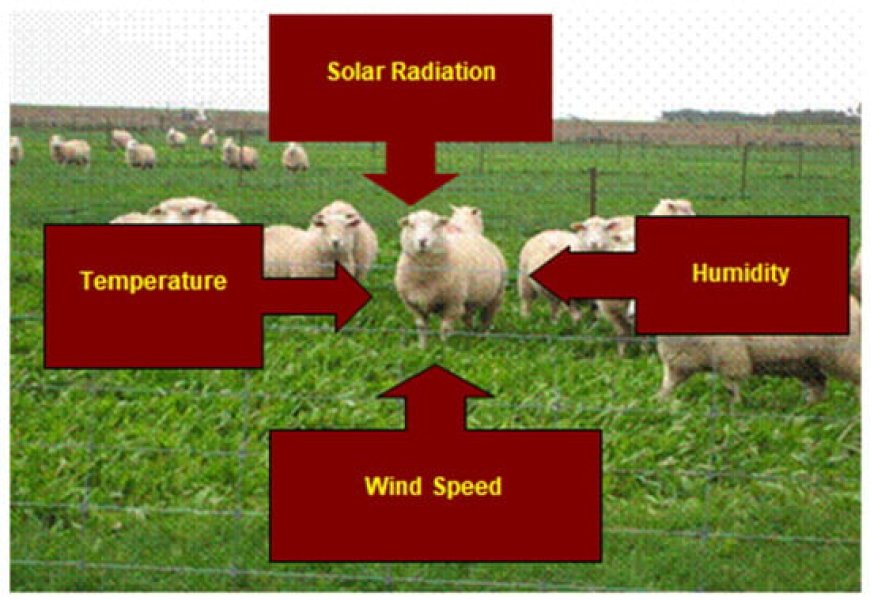
Environmental heat stress is implicated in various animal health issues in ruminants, including reproduction rates, mortality rates, and animal physical quality. During extremely hot weather, there is often no overnight equilibration of animal temperature with its cooling effect, and the accumulated heat load becomes an important factor in animal health for ruminants such as sheep. Using the heat load index (HLI), a heat load model is used as an indicator of heat stress on an hourly basis and annually, using downscaling models for temperature, humidity, solar radiation, and wind speed, in both spatial and temporal cases, across several example sites in regional Victoria. Analysis is provided on the performance of the downscaling models and various adaptation and mitigation options are discussed and tested. These options include using different tree planting patterns to modify solar radiation exposure and wind effects, with mixed results because adding shading structures may also diminish the effect of wind-based cooling. The modelling experiments indicated that (1) heat stress is likely to increase under future climate conditions and could represent a serious threat to the health of small ruminants; (2) adaptation measures by means of tree planting to provide shade may not be sufficient to alleviate projected heat stress; and (3) other adaptation measures will need to be considered. Indicative results for heat stress under potential future environments are provided for 2030, 2050, and 2070. Also discussed is the performance of wind speed modelling, and the effect of heat stress on animal growth and ram fertility.
Environments, Vol. 11, Pages 55: Accumulative Heat Stress in Ruminants at the Regional Scale under Changing Environmental Conditions
Environments doi: 10.3390/environments11030055
Authors: Jean-Philippe Aurambout Kurt K. Benke Garry J. O’Leary
Environmental heat stress is implicated in various animal health issues in ruminants, including reproduction rates, mortality rates, and animal physical quality. During extremely hot weather, there is often no overnight equilibration of animal temperature with its cooling effect, and the accumulated heat load becomes an important factor in animal health for ruminants such as sheep. Using the heat load index (HLI), a heat load model is used as an indicator of heat stress on an hourly basis and annually, using downscaling models for temperature, humidity, solar radiation, and wind speed, in both spatial and temporal cases, across several example sites in regional Victoria. Analysis is provided on the performance of the downscaling models and various adaptation and mitigation options are discussed and tested. These options include using different tree planting patterns to modify solar radiation exposure and wind effects, with mixed results because adding shading structures may also diminish the effect of wind-based cooling. The modelling experiments indicated that (1) heat stress is likely to increase under future climate conditions and could represent a serious threat to the health of small ruminants; (2) adaptation measures by means of tree planting to provide shade may not be sufficient to alleviate projected heat stress; and (3) other adaptation measures will need to be considered. Indicative results for heat stress under potential future environments are provided for 2030, 2050, and 2070. Also discussed is the performance of wind speed modelling, and the effect of heat stress on animal growth and ram fertility.
What's Your Reaction?